
Drafts Pro 50% Off for New Users
For
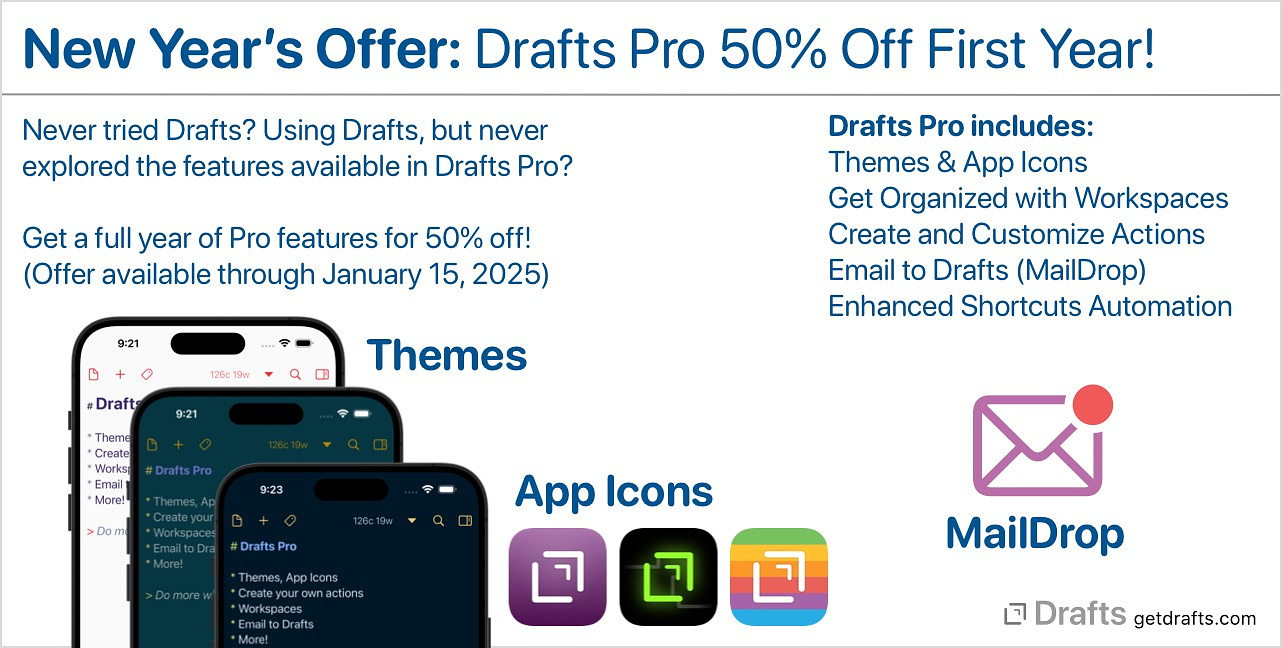
new users, Drafts Pro is 50% off the first year.
Drafts was the first app I installed when I became interested in iOS and Mac automation. The power users of the world explained it to me as the universal quick capture app for my phone. I was advised to always enter text into Drafts no matter where I eventually wanted it to end up. I dutifully put it into my dock, and it’s been there ever since. In this post, I’m going to go over eight different ways I use Drafts. It’s important to note that it pays off to give it a prominent place in your iOS sharing setting for ease of use. On macOS it should show up in the share settings by default.
1. Copy to Obsidian Inbox
I am all in on Obsidian the massively popular note’s app with a robust 1600+ plugin architecture. It does a lot of things amazing well but mobile quick capture is not one of them. To solve that, I use this Drafts action which saves the text to the default save location in my vault and uses the first line of the text as the note title/file name. I use a couple of other Drafts to Obsidian actions including Add to Obsidian Daily Note and Add to Daily Note Plus which add text to my daily note in different ways using a time stamp and a geolocation.
2. The Things 3, Fantastical, Day One Combo
The Quick Journaling Action Group lets me keep one running note that I can process at day’s end to send the individual lines as entries into Fantastical, Things 3 and Day One.
- Lines starting with "-" are collected and sent to Day One as a journal entry
- Lines starting with "⁎" are sent to Things inbox
- Lines starting with "@" are sent to Fantastical
3. Things Parser
Using Task Paper syntax I can create a note in Drafts complete with due dates, areas, projects and tags that get correctly imported into the Things 3 task manager using the Things Parser. I use this with a Drafts template to create daily and weekly checklists for reoccurring tasks. I also use the action group, Things for Things which includes actions for:
- Inbox
- Today
- This Evening
- Tomorrow
- Pick date
- Work
- House
- Personal
- Pick a Project
- Make a Project
- Selection to things
- Bunch of todos
- Process notes from
- Prompt for new task
4. Mail to Evernote
Yep, I still use Evernote for some tasks. Old habits die hard. Evernote eliminated AppleScript a while back and their API has become more and more problematic , but one feature they still support and that works equally well on iOS and macOS is the mail to Evernote feature and this Drafts action accomplishes that without you ever having to use your mail client.
5. Micro.blogging
This blog is hosted by Micro.blog and I
can create entries in Drafts and have them posted online by running an
action. I use the action Post to Micro.blog with
Title by the great blogger Matt
Birchler.
6. OMG.LOL Status
I am a big fan of the almost indescribable web community at OMG.LOL. One of the fun features there is a status board you can share with other members, post on your website and cross-post to Mastodon (where all the cool kids hang out). The OMG.LOL Status action does it all.
7. Run Shortcut to Save to Thoughts Inspiration Manager
One of my favorite things to do online is to collect quotes from various
sources, I save my quotes in an app called Thoughts Inspiration Manager. I
don’t have a Drafts action to write directly to Thoughts but it doesn’t
matter because I have a Shortcut that does. I just need to run the
Drafts shortcut action explained in
the user guide.
8. Personal Assistant
Drafts can serve as an interface with OpenAI by using the Personal Assistant action. (using your own API key) It’s a helpful action to run when you know you are going to use the AI generated text in another app. This action allows the user to get an AI-assisted response to a prompt:
- The user is prompted to enter input, which can be pasted from the clipboard or manually entered.
- The input is then sent to the OpenAI API, and the response is inserted into the current draft 3 lines after the cursor.
- If there is no selected text in the draft, the user is asked if they would like to use text from the clipboard. If the prompt is canceled or the input is empty, the action cancels.
- If there is no response from the API, the output is set to "No reply received."
Access: Secure Passwords Companion
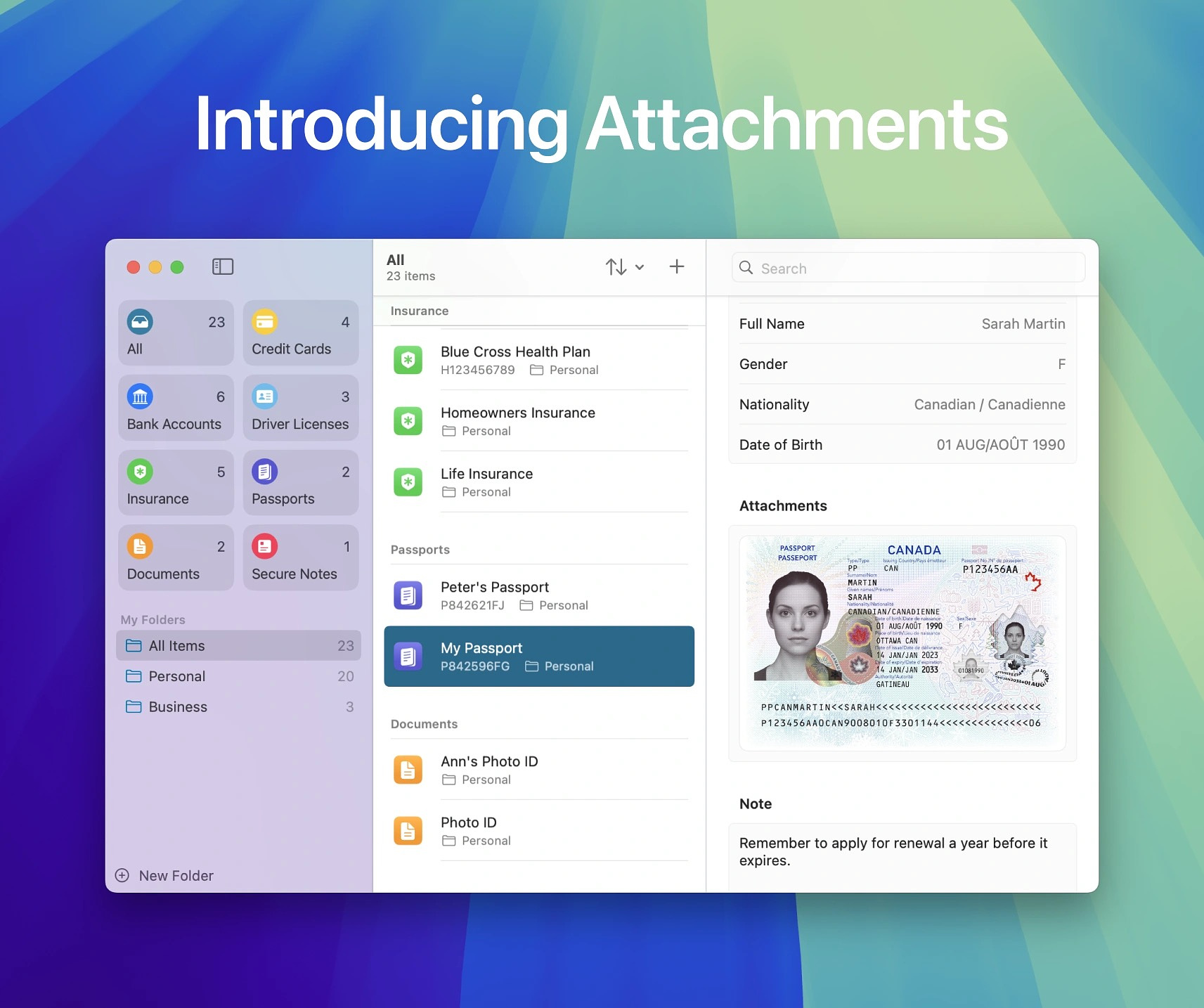
One big feature missing from Apple’s new Passwords App is secure
notes to store data besides passwords. While you can make notes within
the app, it isn’t designed to store that kind of info. You could opt for
the Apple Notes app since it’s secured by the same security and allows
you to password protect individual items with a password. It even
supports templates, but you would have to build them yourself. If you
want a secure, ready-made solution you can use on iOS and macOS, Access may be right for you.
Access has templates for the following kinds of data:
- Payment card
- Bank account
- ID
- Document
- Driver's License
- Insurance
- Passport
- Medical Record
- Rewards program
- Membership
- Software license
- Gift card
- API keys
- Secure personal entries (address book format)
- Notes (useful for all those 2FA code backups)
Every entry has room for user-defined custom fields and attachments, so not only can you have easy to copy info from your important documents, you can also have a photographic copy of them as well.
The layout and appearance of Access is identical to that of the Passwords app. Since privacy is paramount considering the types of data stored in Access, the developer goes into great detail to explain it “Your information is backed up and kept up-to-date across your devices via iCloud. Access is using Apple’s industry-leading iCloud Encryption to protect your information. No data is ever sent to any server other than iCloud. The app doesn’t create, access, or store keys for any encrypted data. With Advanced Data Protection for iCloud, all Secure Data stored in Access is end-to-end encrypted and is inaccessible to the Developer, Apple, or any third party at all times. For an added layer of security, Access supports authentication with Touch ID. All data stored in Access on your device is automatically encrypted and decrypted by the system.”
Access has a free version with limited functionality, but to get access to every feature, you’ll need to purchase lifetime access for $29.99 or subscribe for $9.99 yr/$3.99 mo.
Cronica - A Free, Privacy Focused Media Tracker for Mac and iOS

There are many paid options to discover and track movies and TV
shows, most of them being subscription-based. Cronica, donation-ware
from Egger, Inc., full-featured right out of the box, with no limit on
usage. The app can be employed for various purposes:
- Tracking episodes of TV shows or movies you've already seen
- Discovering new movies and shows through trailers and descriptions from The Movie Database (with an option to watch the trailers via YouTube)
- Notifications when movies are released or new episodes of shows air
- iCloud syncing between your Mac and iOS devices - no account required with the app's developers
- Get suggestions based on your watch history
- Share links with others from within the app, using The Movie Database
- Suitable for international audiences. Allows users to choose a region.
Cronica is available for download from the Mac App Store.
Sloth - Activity Monitor on Steroids

Sloth is a free and open-sourced app that’s been around for twenty
years. It provides an app by app breakdown of all open files and sockets
in use by all running processes on your system. This makes it easy to
inspect which apps are using which files and sockets. In activity
monitor, you get information on processes, but not on what app they
belong to or where they are located on disk. Every so often, when you
are troubleshooting an obscure problem, you need that information. I
recently had to track down what app was causing my Mac to slow to a
crawl every time I encountered an open/save dialog box. Sloth was
helpful during that process.
You may end up surprised at some processes running on your box. Despite everything I have tried, the inescapable Adobe virus insists on running some process whenever my computer is on, despite having all their apps set to not run at login.
Features
- View all open files, directories, IP sockets, devices, Unix domain sockets and pipes
- Filter by name, access mode, volume, type, location, or using regular expressions
- Sort by name, process ID, user ID, process type, bundle identifier, etc.
- View IP socket status, protocol and version
- View sockets and pipes established between processes
- Inspection window with detailed macOS and Unix file/socket/process info
- Powerful contextual menu for file operations
- In-app authentication to run with root privileges
Sloth is available on GitHub and can be downloaded via Homebrew.
$ brew install --cask sloth
Ente Auth - The Free Authy Replacement for Your Mac and iPhone
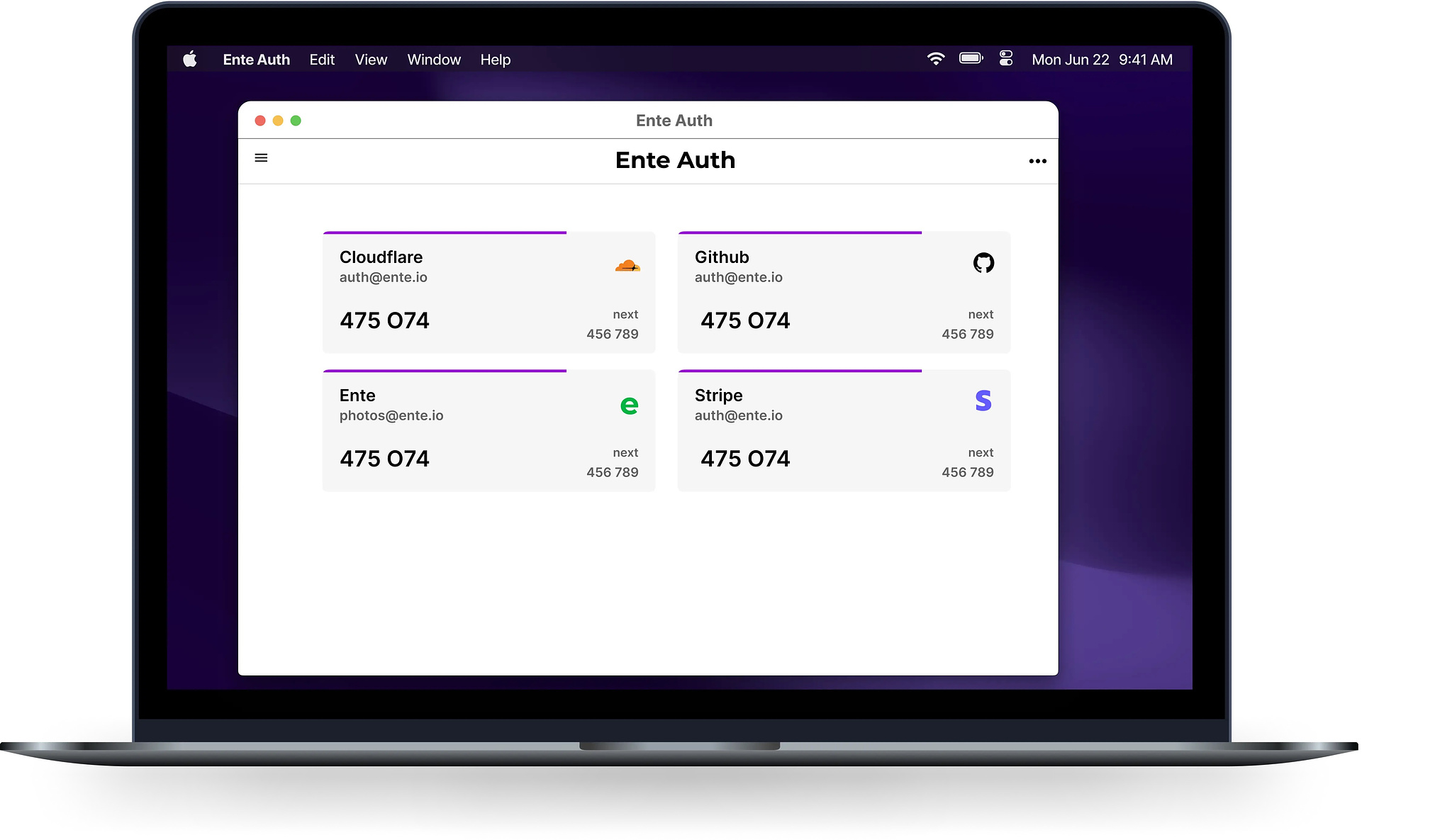
If you miss the Authy 2FA desktop app, and you would rather not
use Apple Passwords, since if you were to lose access to your Apple
account, you would lose access to all your codes, Ente Auth is a free and open-source
option. You have the option to create an account if you want to sync
your codes between devices, or you can skip that if you just want to use
it on a single device.
The desktop version of Ente Auth has some nice features I haven’t seen elsewhere. Not only does it show you the current 2FA code for your app, it also shows you the next code in the sequence. This eliminates the aggravating wait for the codes to change when there are only a few seconds left in the lifetime of the current code. You can also configure the desktop app to open directly to the search field, so you can immediately begin searching for the code you need.
It can be a hassle to set up a new authenticator, since you have to manually add sites. Most do not allow you to use more than one app to do 2FA. Still, it is a one-time chore and worth it for the convenience of having a secure desktop app with end-to-end encryption.
Thanks to Justin Pot for his article on Lifehacker about Ente Auth.
SingleFile - For Safari and Other Mac Browsers

Attempting to save a web page to your local computer often results
in multiple files and folders downloaded. A recently updated plugin for
Safari, Chromium browsers and Firefox provides an elegant way to get
everything you need in a single HTML file, downloaded with the click of
a button in your browser’s toolbar. You can choose to download only the
selected text or a single frame from within the page. Any page that you
download can be annotated with tools included within the plugin. The
annotation tools also allow you to remove content you don’t need or
want.
Not only can you download a single page and its elements, you can select multiple tabs at once and download them all with a single click. Another option saves a local HTML files of any page that you bookmark. You can control the destination of the saved files, saving them to a cloud drive like Google Drive or iCloud.
You can get SingleFile from wherever you obtain extensions for your particular browser type. The overall project is on GitHub where you can get support.
Mac Translation Apps - Offline, Google and DeepL

Most modern browsers have multi-language translate built in.
Vivaldi even has a separate panel for it. Sometimes, though, we
encounter text in other languages in books and documents or when we
aren’t connected to the Internet. Then it’s not possible to use a
browser. Also, even though Google Translate is the de facto standard,
there are other translation engines that some feel are better. Here are
a few options.
Translator - Offline Translate
If you want a tool for Mac that works when you don't have a connection, this is what you need. It's only 3.99 in the Mac App Store. It is a one-time purchase, not a subscription and installs as a menu bar app. One drawback is a limited number of supported languages when compared to online versions. It supports:
- Arabic
- Chinese (Mandarin - China Mainland)
- Chinese (Mandarin - Taiwan)
- Dutch
- English (US)
- English (UK)
- French (France)
- German (Germany)
- Indonesian
- Italian (Italy)
- Japanese
- Korean
- Polish
- Portuguese (Brazil)
- Russian
- Spanish (Spain)
- Thai
- Turkish
- Ukrainian
- Vietnamese
Google Translate Web View
This free app is a web view wrapper for Google Translate that operates from your menu bar and can be summoned with a hotkey. It is available on Github. It has a limit of 5,000 characters at a time. It does have built in OCR for images, so you can upload those to have them interpreted. Google Translate offers automatic language detection if you are unsure what you are dealing with. This is an unsigned app, so you will have to give permission to bypass Gatekeeper. Google supports translation into 108 languages.
DeepL
Some feel the private company, DeepL, offers a product with superior translation abilities when compared to Google. It's paid services offer the ability to upload and translate large documents, including PDFs. The free service provides you with three documents a month of up to 5MB and, like the other apps in this review, provides real-time translation from the menu bar. DeepL supports the following languages:
- Arabic
- Bulgarian
- Chinese (simplified and traditional)
- Czech
- Danish
- Dutch
- English (American and British)
- Estonian
- Finnish
- French
- German
- Greek
- Hungarian
- Indonesian
- Italian
- Japanese
- Korean
- Latvian
- Lithuanian
- Norwegian
- Polish
- Portuguese (Brazilian and European)
- Romanian
- Russian
- Slovak
- Slovenian
- Spanish
- Swedish
- Turkish
- Ukrainian
iCollections - A Desktop Centric Workflow Manager Similar to the Classic Dragthing
The late, great Mac app, Dragthing reached end
of life in 2019. It was a point and click workflow manager for those who
preferred that type of workflow over apps like Alfred and Launchbar. The
developer of Dragthing was an Apple employee to worked on the original
implementation of the dock in Mac OS X. He created Dragthing as an
alternate version of what the dock could have been. It was an immensely
popular app among power users and won many awards in its 24 years on the
market (1995-2019).
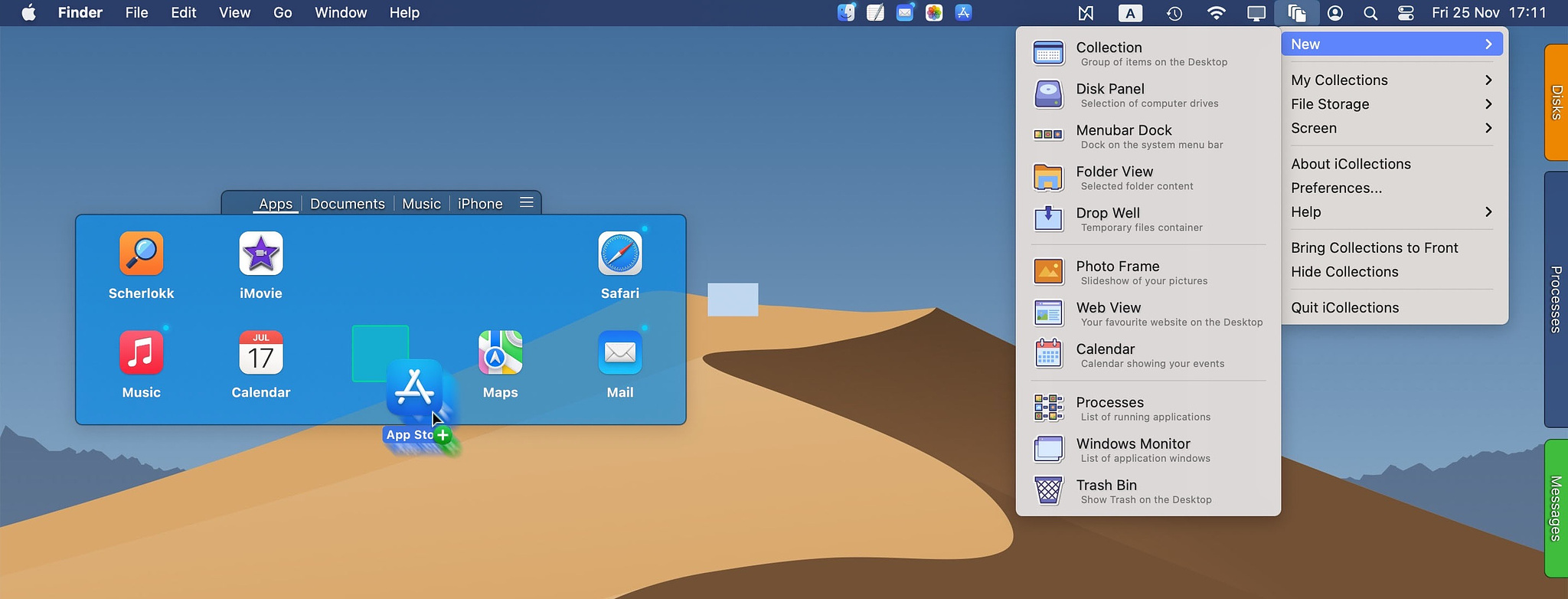
iCollections by developer Grzegorz Staszczyk provides an experience much like Dragthing once did. It provides a a variety of desktop interfaces for various ways to view content and control your Mac. The interface is based on what the app calls collections. These are windows or drawers containing any one of the following elements:
- Disks (including external storage and mounted disk images)
- Access to dock items from the menu bar
- Folders (e.g., Downloads, Documents) - use tabs to see multiple folders in one window
- Drop shelf for temporary file storage
- Photo frame (with slide shows)
- Web view using iOS user agent for any website
- Open processes
- Open Windows
- Trash
- Calendar
Every element has multiple customization options including color, size, position and opacity. You can use custom icons, even for native Mac applications, something you cannot do in Finder. You can combine keyboard shortcuts with point and click functions to summon collections when you need them. To use a folder as a launcher, just add application aliases to it.
iCollections can be downloaded from the developer’s website to take advantage of a free trial. It can also be downloaded from the Mac App Store. The cost is:
- Monthly Subscription$2.99
- Annual Subscription$12.99
- Lifetime License$39.99
mtop - A Resource Monitor for Crowded Menu Bars

I regularly check MacMenuBar.com for new additions.
Today i found a nice little app called mtop.
It’s a monitor for each CPU core, your GPU and your RAM. It also
provides PIDs for running processes. Apps like iStat Menus and Stats are
great at doing this, but they take up far too much room in the menu bar
for my taste. I just want a single icon I can click on to get the
information I want. I don’t need a heads-up display.
There isn’t much to configure in mtop. You can choose one of eight different themes. Clicking a button reveals the running processes, which are hidden by default. The app is available in the Mac App Store for $.99.
Simplenote - Free, Rock Solid and Dependable for Over a Decade

Simplenote by Automattic is a
free cross-platform plain text / Markdown notes app for macOS, iOS,
Android, Windows and Linux. It’s been around for over a decade and I
have never known it to go down. Automattic is the company behind Word
Press and Day One, so it’s no fly-by-night enterprise.
One of the primary benefits of using Simplenote is the speed. It syncs behind the scenes and opens quickly, regardless of platform. Each note has a history, and you can view changes you’ve made to it over time. Notes are easy to share on a Mac using the system share sheet. If you don’t have access to a device on which you have Simplenote installed, you can get to your notes in a browser.
Notes in Simplenote are organized by tags. Use as many as you want. You can also do simple searches of your notes via text strings. Simplenote is compatible with Apple’s new writing tools, which means you have access to dictation, proofreading, rewriting, spelling and grammar correction. Information about each note, including creation date, modification date, character count and word count is available at the click of a button. Like most modern apps, Simplenote has a light and dark mode. You can also control the default text size. Important notes can be pinned to the top of your notes list.
The Simplenote API is open to developers. There are several other note-taking apps on various platforms that can access your notes database. On such app is nvPY for macOS.
Commander One as a Finder Replacement

The Mac Finder is fine for casual users, but if your use cases
involve a lot of file management to handle photography or videography
related tasks, heavy downloading, web publishing or other more advanced
tasks, you’d be well served to look for a replacement. Commander One by
Electronic Teams, Inc. Is a serviceable option. It has a dual pane
interface, with each pane featuring unlimited tabs. There are three view
options per pane: details, list and icons.
The Commander One features list is long:
- Easily toggle hidden files
- Customizable fonts and colors
- Bookmark favorite file locations
- Customize any of the numerous hotkeys available for file actions
- Queue file operations
- ZIP support
- Built in file viewer
- Root access to files
Search
- Regex support
- Search file contents
- Built in advanced search plus Spotlight search
Pro Pack
All of the features listed above are part of the free version of Commander One. If you purchase the Pro Pack for $29.95 you get the following:
- FTP Manager
- Access connected MTP, iOS and Android devices
- Connect to Dropbox, Google Drive, Amazon S3, Box, OneDrive, BackBlaze, WebDAV
- Terminal Emulator
- Advanced compression and decompression tools
Other Finder replacement options are Qspace and Pathfinder.
Cloud Storage Management Apps

The longer you use a computer, the more access to resources you
accumulate. I’m old, so I have more accounts than I know what to do
with. When it comes to cloud storage, I have access to Google Drive, One
Drive, Box and Dropbox, although I only pay for Google Drive. I once
signed up an entire middle school’s faculty to Dropbox with my referral
link, so I have a large sized free tier. I got 50GB from Box so long ago
that I no longer remember how. OneDrive is provided by my job.
Each of these providers, along with other cloud storage solutions, provide their own software for mounting your storage at login. There’s no way I want to have four separate apps running in the background when I can consolidate them into one app that does the same thing and in some cases provides more utility. Mac users can choose between three types of access. I prefer using a network drive mapper. The app I use is CloudMounter because it is included in Setapp, although it often goes on sale. A similar product, Mountain Duck, is currently on sale for $7 at Bundlehunt.
Here is a list of options for Mac users.
File Managers/Browsers
- Odrive - $99 a year
- Multcloud - $189
- Raidrive $34 a year (limited free tier)
- Expandrive $75 lifetime
FTP/SFTP/Cloud Clients
Mounters (Network Drive Mappers)
- MountainDuck - $39
- CloudMounter - $75
- Netdrive - $50
Royal TSX for Remote Management

In my day job, I provide IT support at a small private university.
Because I have a good boss, the computer I use as a daily driver is an
M3 iMac. Most of the users I support are using Windows 10 and 11,
however. Microsoft doesn’t make a version of server tools for ARM
processor-based computers. This means that I am unable to use a VM to
run Windows apps like Active Directory Users and Computers or SCCM. On
my Mac, I can use browser-based tools like InTune and Entra, but for
other apps, I rely on a remote connection to a Windows machine for
access to the tools I need.
My solution is the lite version of the app, Royal TSX. This free version lets me use up to 10 connections to remote computers and 10 sets of credentials. I primarily use the RDP plugin, but Royal TSX also supports:
- TeamViewer sessions
- Apple Remote Desktop and VNC
- Terminal sessions
- File transfers
- VMWare connection
- HyperV connections
- Running Power Shell scripts on remote computers
When I have issues using the new Windows app for RDP for unknown Byzantine reasons, Royal TSX comes through and allows me to connect. It's a neat tool to have in my bag. The paid version is $53 and allows unlimited connection and unlimited credentials.
Remote Helper for Mac

Remote Helper for Mac is
the companion for the iOS app, Remote
Mouse and Keyboard. When used together, your iOS device can control
a Mac, a PC, an Apple TV or an iPad.
The features include:
- Control the cursor on a Mac and serve as a virtual mouse to select, double click or right click any element
- Enter text on a Mac from the iOS keyboard
- Media controls - mute, pause, volume up, volume down, next track, previous track. Works in multiple apps
- View your computer screen on your phone
- Issue system commands from your phone to your Mac - sleep, shut down, restart
- Launch any app on your Mac from your phone
- Use Siri on your phone to send commands to your Mac
- Run custom AppleScripts on your Mac from your phone. An example script is included that opens Netflix in the Chrome browser.
The Mac app is free to download, but it requires the iOS app to actually do anything. The iOS app has a lifetime purchase. The amount differs depending on where you are. Today in the US, it was $10. There is an option to subscribe on a month by month basis for $1.99 with a seven-day free trial.
Four Single Purpose Apps - Cheap/Free

There's something to be said for apps
that do one thing well. Here are a few that I've found lately.
FNable - If you use your function keys much, you may grow tired of having to toggle them with the FN key. Be default, macOS treats function keys as system controls. This little app allows you to toggle the behavior simply be pressing and holding the FN key for three seconds. You definitely want to find this app on sale though. It is regularly priced at a whopping $25 . It is currently available at Bundlehunt for $1.50.
- Quill is a menu bar notes app similar to Scrap Paperand Scratchpad with one big difference, you can use images in Quill notes. The notes sync across Macs, but there isn’t an iOS app. You can, however, export your Quill notes easily enough if you want to view them on your phone. It is $.99 in the App Store.
Trace - Trace is a minimalist time tracking app. When you manually start a session of, it records the apps you work on and the time you spend in them. You can pause and resume sessions. It reports the amount of time you spend in each app and other facts, like your most used app. It is a free app. For more detailed automatic reports, try Activity Watch, also free.
SpaceSaver - With SpaceSaver, you can save the state of your open applications and windows, and easily restore them later. You can have multiple sessions and switch between them with ease. It doesn’t have the prettiest interface but what it lacks in aesthetics, it makes up for in function and price - free!
Browser Deputy from the Folks at Anybox

These days, it is not uncommon for someone to have hundreds of
open tabs in as browser. I usually run about 40-50 myself. I’ve tried
several solutions to quickly find the tab I’m looking for without much
success. Since installing Browser Deputy, I’ve been
pleased with the way it incorporates into my workflow. I can summon the
app with a hotkey and quickly find a tab, a bookmark or an item from my
browser history, no matter what app I am in.
Browser Deputy works with the following browsers:
- Safari
- Chrome
- Edge
- Brave
- Firefox
- Vivaldi
- Opera
- Arc
Aside from providing a quick search for browsers, Browser Deputy also lets you perform web searches with various built-in engines or custom ones that you add yourself. I use a custom Google search that removes all the AI crud and provides the good old ten blue links that we once took for granted. It was easy to add to the list.
The other useful feature in Browser Deputy is the ability to search menu commands in whatever open app you happen to be in, not just browsers. It doesn’t give you a heads-up display of the commands like KeyClu, but it will activate any command you search for.
Browser Deputy is available for download from the dev’s website. A three machine license is $11.99.
Language Tool - Free is Good, Paid is Better, but Expensive

Mac apps have had rudimentary built-in grammar checkers for a
while. Grammarly was the first
well-know commercial product to elevate the capabilities of that tool
genre, becoming extremely popular with students in particular. Lately,
LanguageTool has surged in
popularity. It is integrated into many well-known writing apps across
multiple platforms, including macOS and iOS.
Professionally, I am tasked with composing Confluence (knowledge base) documents for Jira, the ticketing system my job uses. Personally, I maintain three blogs as a non-monetized blogs as a hobby. I write a lot as a result. I have been using the free version of LanguageTool for a couple of months. It does a better job than the native spell checkers I previously used, and it helps with things like missing commas and omitted words. I took advantage of a Black Friday sale to sign up for a year on the Pro Plan. As a result, the app now has a much larger range of tools for me to use.
LanguageTool has a plugin for Safari, Firefox and Chromium browsers. It has a tool specifically built for Microsoft Office, Google Docs, Apple’s Pages and LibreOffice. For email users, it works with Apple Mail, Outlook, Thunderbird and Gmail. It even has a plugin for Obsidian, where I do most of my writing. On a Mac, it is also optimized for uses in other apps like Messages and Notes. There is a native editor app for Mac users.
Language Tools’s capabilities are sizable.
-
Grammar
- Word order
- Verb tenses
- Subject/verb agreement
- Commas and in-depth punctuation
-
Style
- Repetition
- Over-used words and phrases
- Wordiness
- Foreign terms
-
Semantics
- Lack of clarity
- Word confusion
- Double negatives
-
Format and Typography
- Consistency for numbers and letters
- Spacing
- Time and date formats
-
Spelling
- Misspelled names and acronyms
- Casing errors
- Easy to import your Mac's personal dictionary
LanguageTool works not just with English, but with many other languages as well. It provides detailed stats on what it has done to aid you in writing. You can use a limited feature set or turn on what it calls "picky mode" for more frequent suggestions to strengthen your writing. It does not duplicate what macOS and ChatGPT offer in so far as it does not change the tone of your writing, but it will paraphrase sentences for you.
I am pleased so far with the suggestions I receive from LanguageTool. It definitely makes what I write more polished. It is not a cheap tool. Without the Black Friday discount, it is $5.83 a month, or $70 a year. Casual users can get plenty of benefits from the free plan, while students or more serious writers can benefit from deciding to go pro.
Folder Tidy - On Demand Fast Power

Folder
Tidy by Tunabelly Software is a tool anyone can use to perform quick
sorts on any giant directories of files that seem overwhelming to tackle
manually. It has built in sorting rules for 19 different types of files,
including folders. These rules can be toggled on or off, but you cannot
edit them. In addition, you can make your own very granular rules. The
example they give is representative of the power of the app. “Move all
files with the extension “DOCX” that contain the word “invoice” and were
last modified in the past year to a folder labeled “Invoices.”
What’s remarkable is the speed at which Folder Tidy operates. It uses macOS technology called Grand Central Dispatch to use all available cores to accomplish the tasks you assign it. In my case, it took about a second to sort and move directories with hundreds of different media files to subfolders on a different drive. I had to do some troubleshooting after it failed to move all the files on the first try. It turns out that my Spotlight database needed to be rebuilt, a problem I’ve had before which also affects some search utilities, like Houdah Spot, that rely on it.
Folder Tidy is not a replacement for Hazel. While it does what it sets out to do quickly and well, it is a file sorting utility that doesn’t have the depth of actions that Hazel does. If you already own Hazel, there is no reason to add Folder Tidy. One other important thing to know is that Folder Tidy is a manual app. It doesn’t watch folders and run action on the enclosed items automatically.
I paid $2.49 for the app on Black Friday. It is ordinarily $9.99.
Black Friday Software Sales

It’s time for all the AppAddicts out there to load up during the
yearly bargain day called Black Friday. The sites listed below have some
repetition, but take a quick look through all of them. Some contain
software for specialty roles, like devs, creators and designers.
So far this year, I’ve purchased:
Sales
- Rare Deals and Discounts on Software, Apps & SaaS
- Black Friday - Indie Goodies
- Black Friday WordPress Deals 2024 - wpbfdeals
- Awesome-Black-Friday-Cyber-Monday: Awesome deals on Black Friday: Apps, SaaS, Books, Courses, etc.
- Best Black Friday & Cyber Monday 2024 Deals for Developers & Designers
- SaaS Black Friday 2024
- Awesome-Black-Friday-Cyber-Monday-deals: 🟢 2024 Deals Live - Black Friday & Cyber Monday, Christmas & Holidays Deals for Developers, Techies, & Entrepreneurs,
- Black-Friday-Deals: Black Friday Deals for macOS / iOS Software & Books
- Indie App Sales!
- Discover Launch Deals on Indie Products
- DealHunt - Free Curated Deals with Savings up to 80%
- Black Friday Times, unmissable deals on software, services and more.
- Creator Black Friday Deals
MacWhisper - Transcription Powerhouse

I made my first purchase of the 2024 Black Friday season by
purchasing the transcription app, MacWhisper by
indy developer Jordi Bruin for 40% off of the usual price of €49.99.
This app uses OpenAI’s Whisper technology to transcribe all types of
audio files with quickness and accuracy into text.
It requires macOS 14 or higher and works best on Apple Silicon, although it is functional on Intel processors. You can use any type of input device, including your Mac’s built-in microphone. MacWhisper can, if you choose, replace the built-in dictation on your computer. Transcription is done on your device, not on a remote computer. The default output is a .whisper file containing the original audio and the transcribed text, however it has numerous export choices:
- SRT and VTT subtitles
- CSV
- DOTE
- DOCX
- Markdown
- HTML
The transcription speed is remarkable, happening up to 30X over real time using metal and GPU technology. Transcripts may be easily searched. Filler words (um, ah, etc.) are automatically removed. You can edit the transcripts to correct spelling of names or other words.
With the Pro version of the program, I get batch transcriptions of multiple files. I can transcribe YouTube video and use my OpenAI key to take advantage of Cloud Transcription and ChatGPT integration. I can take advantage of translation services to convert text into other languages. It also adds a menu bar interface for global transcription and the ability to paste text into other apps.
Students, non-profits and journalists always get 50% off the price by contacting the developer. There is a free version of the app that lacks the AI integration of the Pro version. It is available on Gumroad.