
BarCuts Brings Order to Your Shortcuts Menu
I make extensive use of shortcuts all day long on my Mac. I use
them to import data into Obsidian, generate alt-text for images I post
on my blog or social media, query Open.AI, dismiss notifications, quit
all apps, launch multiple apps at once, perform backups and so much
more. In the past, I've made extensive use of the option to add
shortcuts to a native menu running from the Mac menu bar, but over time
the list grew long and more difficult to mage.
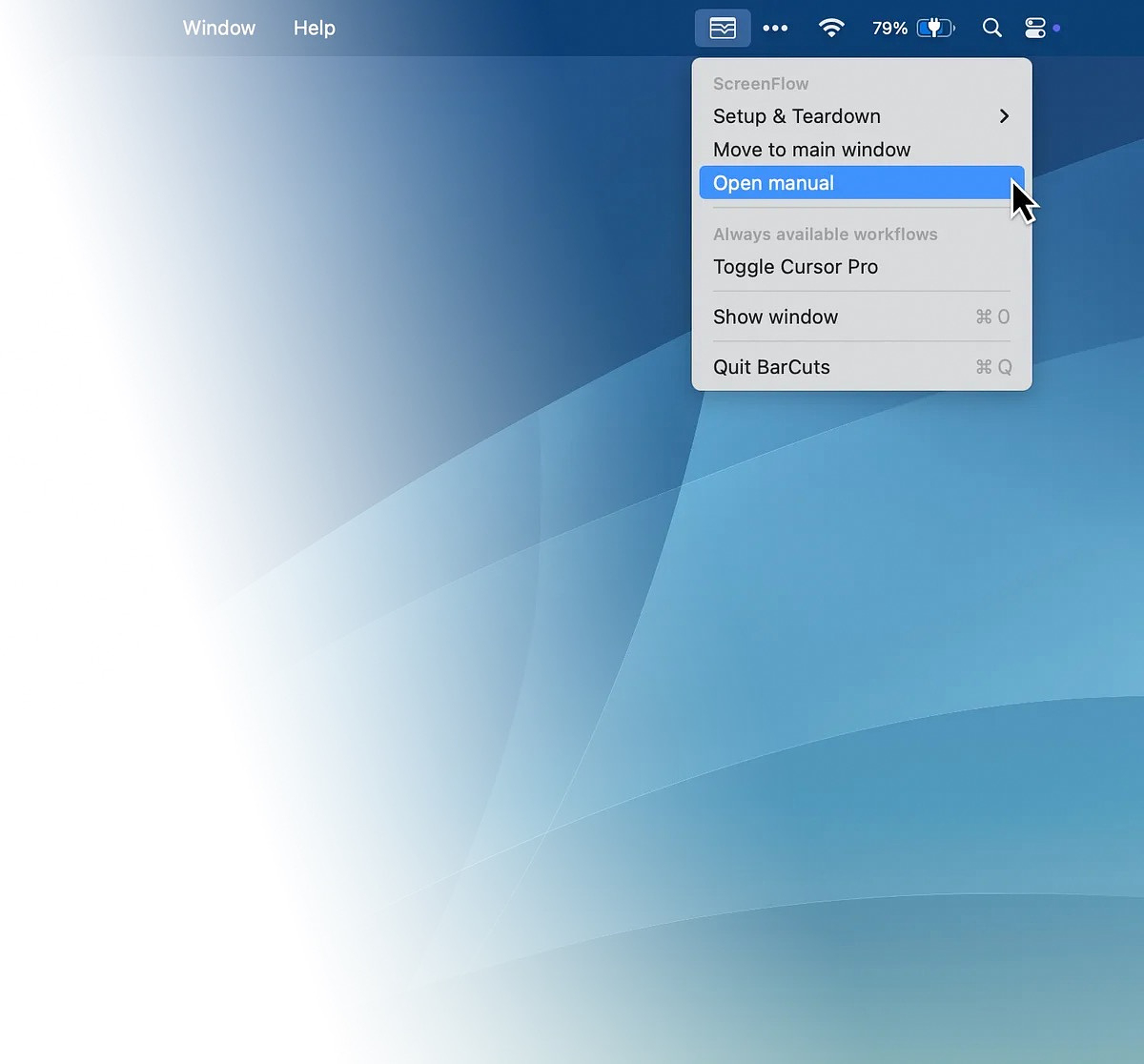
Just in the nick of time, one of the friendliest and most helpful developers on the planet, Germany's own Carlo Zottman, released a small app called BarCuts. It also runs from the menu bar, but only shows shortcuts that work in the currently active app, plus ones that you decided you always want to have available.
This means that when I am in Obsidian, I see shortcuts to import a weather report and copy the day's appointments into my daily note. When I use any other app, I don't see those shortcuts. When I am in Safari, I see the shortcut I use to open paywalled site at the Internet Archive.
I always see the shortcuts for emptying my trash and dismissing all the notifications from the Notification Center. All you have to do to configure your options is to add a single Shortcuts action at the end of your existing shortcuts.
Because Carlo is good at what he does, "the menu can also be opened by a global keyboard shortcut, you can put your workflows in sub menus, and there's a separate section for all those important always-available workflows.
Naturally, BarCuts comes with scripting support, and you can also hook it up to Alfred or plug it into Raycast."
BarCuts has a two-week fully functional free trial. Licenses are €12 personal/€24 business and include updates for one year. You retain ownership and use of the app as long as it is compatible with macOS. There is no subscription.
For more shortcuts add-ons, see this review. Enhance Apple Shortcuts with These Apps | AppAddict
A Mac Guy Gets Into Self-Hosting

Before 2025, my self-hosting experience had been limited to
running the media server software, Plex, on a 2009 iMac. When I retired
that machine, I didn't resurrect Plex on my new Mac, although I did hang
on to all the media files. I retired myself this year and resolved to
start self-hosting some services as a learning experience. My home
network consists of three Mac laptops, a Lenovo ThinkPad, that 2009 iMac
I mentioned, plus five iOS devices and an Amazon Kindle Fire (Android).
I elected to use the ThinkPad as a server, although the platform I chose, Unraid, will also run on a Mac. Many of the services it hosts are fully accessible on Mac and iOS devices. I picked Unraid because I have contacts who use it. It is not FOSS. A license that allows you to connect six hard drives in a RAID array is $49.
Unraid Benefits
• 1 year of free OS updates
• All Unraid OS features
•
Perpetual Starter license
• Access to Community Apps
• VM
and Docker Management
• Integrated Tailscale + VPN Support
•
Network-Attached Storage Dual Parity Protected Array, ZFS, BTRFS, XFS
Pools
In the two weeks I've been using it, I have installed a media server (Plex), a photo management server (Digikam), file sharing (Syncthing), and the Mac compatible VPN, Tailscale that allows geographically distant devices to interact as if they were on a LAN.
Other services I plan to investigate are:
- Nextcloud - a personal alternative to Dropbox, Google Drive, One Drive etc.
- Self-hosted Calibre ebook server
- Paperlessngx - a document management system
In seeking advice from experienced self-hosting folks, I
received this detailed answer from a friend on Mastodon, @phillip@omg.lol
Unraid
"Unraid is probably the easiest turnkey solution if you have the cash to
throw at it. Easy App Store, Docker, VMs, NAS, etc. It stays easy while
leaving you tons of headroom to grow. There’s also a huge community with
tons of resources and docs behind it. The main con here imo is money.
Some have complained about performance issues, but afaik that’s only in
larger NAS setups."
yunohost
yunohost.org is pretty slick and even has its own App Store to make
downloading new apps dead simple. However, it doesn’t use Docker
containers (harder to switch to another platform later like Unraid) and
seems to prefer opening ports publicly. That not may be a con if you
were already planning on doing that anyways.
Yacht
For free + docker, I’d recommend a dashboard app like Yacht (or Dockge for even simpler). You’ll need to manually configure your apps, but it’s generally pretty straightforward and a “set it and forget it” kind of thing.
A Mac Guy Gets Into Self-Hosting

Before 2025, my self-hosting experience had been limited to
running the media server software, Plex, on a 2009 iMac. When I retired
that machine, I didn't resurrect Plex on my new Mac, although I did hang
on to all the media files. I retired myself this year and resolved to
start self-hosting some services as a learning experience. My home
network consists of three Mac laptops, a Lenovo ThinkPad, that 2009 iMac
I mentioned, plus five iOS devices and an Amazon Kindle Fire (Android).
I elected to use the ThinkPad as a server, although the platform I chose, Unraid, will also run on a Mac. Many of the services it hosts are fully accessible on Mac and iOS devices. I picked Unraid because I have contacts who use it. It is not FOSS. A license that allows you to connect six hard drives in a RAID array is $49.
Unraid Benefits
• 1 year of free OS updates
• All Unraid OS features
•
Perpetual Starter license
• Access to Community Apps
• VM
and Docker Management
• Integrated Tailscale + VPN Support
•
Network-Attached Storage Dual Parity Protected Array, ZFS, BTRFS, XFS
Pools
In the two weeks I've been using it, I have installed a media server (Plex), a photo management server (Digikam), file sharing (Syncthing), and the Mac compatible VPN, Tailscale that allows geographically distant devices to interact as if they were on a LAN.
Other services I plan to investigate are:
- Nextcloud - a personal alternative to Dropbox, Google Drive, One Drive etc.
- Self-hosted Calibre ebook server
- Paperlessngx - a document management system
In seeking advice from experienced self-hosting folks, I
received this detailed answer from a friend on Mastodon, @phillip@omg.lol
Unraid
"Unraid is probably the easiest turnkey solution if you have the cash to
throw at it. Easy App Store, Docker, VMs, NAS, etc. It stays easy while
leaving you tons of headroom to grow. There’s also a huge community with
tons of resources and docs behind it. The main con here imo is money.
Some have complained about performance issues, but afaik that’s only in
larger NAS setups."
yunohost
yunohost.org is pretty slick and even has its own App Store to make
downloading new apps dead simple. However, it doesn’t use Docker
containers (harder to switch to another platform later like Unraid) and
seems to prefer opening ports publicly. That not may be a con if you
were already planning on doing that anyways.
Yacht
For free + docker, I’d recommend a dashboard app like Yacht (or Dockge for even simpler). You’ll need to manually configure your apps, but it’s generally pretty straightforward and a “set it and forget it” kind of thing.
Five New to Me Apps for a New Week
iDrive Cloud Backup
From Assaf at Labnotes - IDrive Cloud Backup I started looking into Backblaze alternatives, and so far iDrive is a strong contender. I chose the mini plan, 500GB of backup for $9.95 a year (it’s somewhere in the UI, look it up). It does have continuous backup, but so far I’m happy just running on a schedule. Can’t figure out how to get it to ignore repeat directories like every node_modules, or limit by file type/size (eg don’t backup large videos). And the UI is not pleasant, but neither is Backblaze (their restore is overly complicated), so just trading one deficiency for another. Oh, but they do give you 100GB of space to sync files between your devices.
Command Keeper
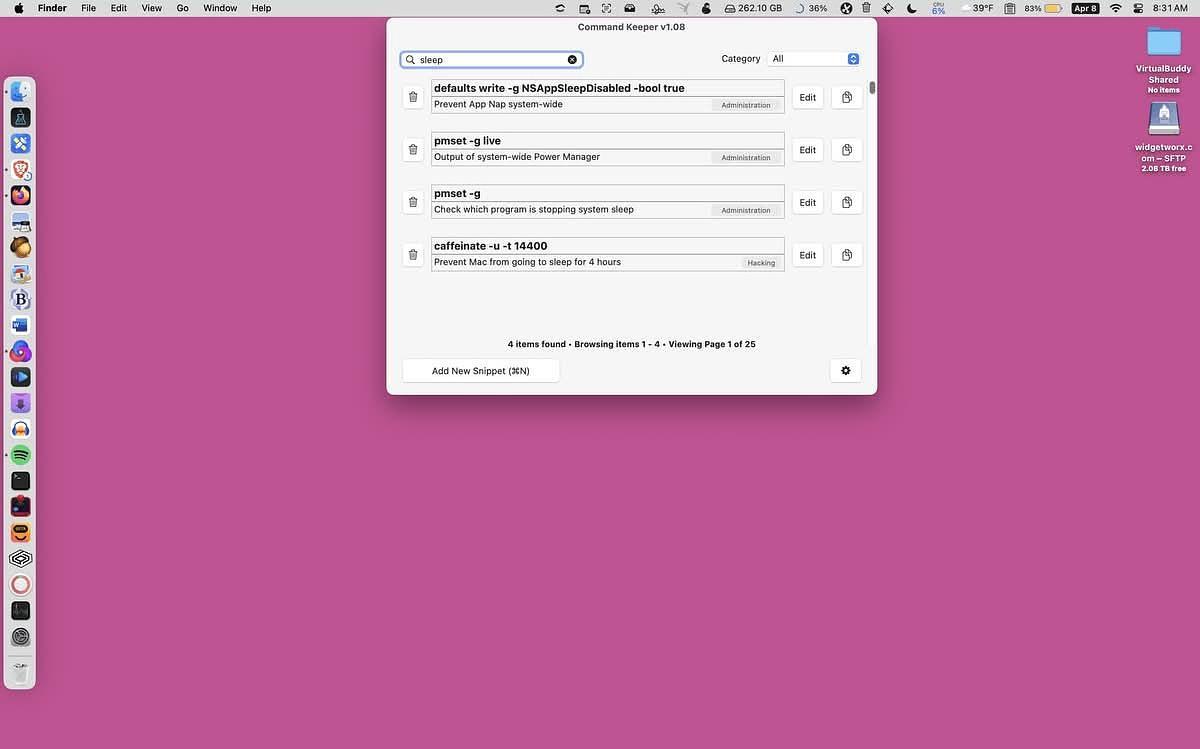
Command Keeper by Ari Feldman - Use Command Keeper (Free) to easily organize and access your command line snippets, shell scripts, and even SQL queries. It's ideal for app developers, web developers, or just anyone who needs to spend time working with command line interfaces.
- Build a Big Collection: Add or edit up to 999 command snippets (each can be up to 4K in size)
- Save Time: Automatically insert the selected command or query directly into your Terminal. Command Keeper works with your choice of the macOS Terminal or iTerm, Warp, and Ghostty (if installed)
- Always Ready: Runs in the background, so its always available and you can even pin your favorite snippets to always appear first
- Powerful Filtering and Search: Filter your snippets by category and search your snippets by command, description, and even notes contents
- Keyboard Friendly: Use keyboard shortcuts to create snippets and browse through snippets efficiently
- Preserve Your Data: Export your snippets to a CSV or JSON file and backup your snippet database
- Fast and Lightweight: Its simple and minimalist design ensures it’s light on resources
- Wide Compatibility: Works on macOS Ventura, Sonoma, and Sequoia; optimized for Intel and Apple Silicon CPUs
Readeck
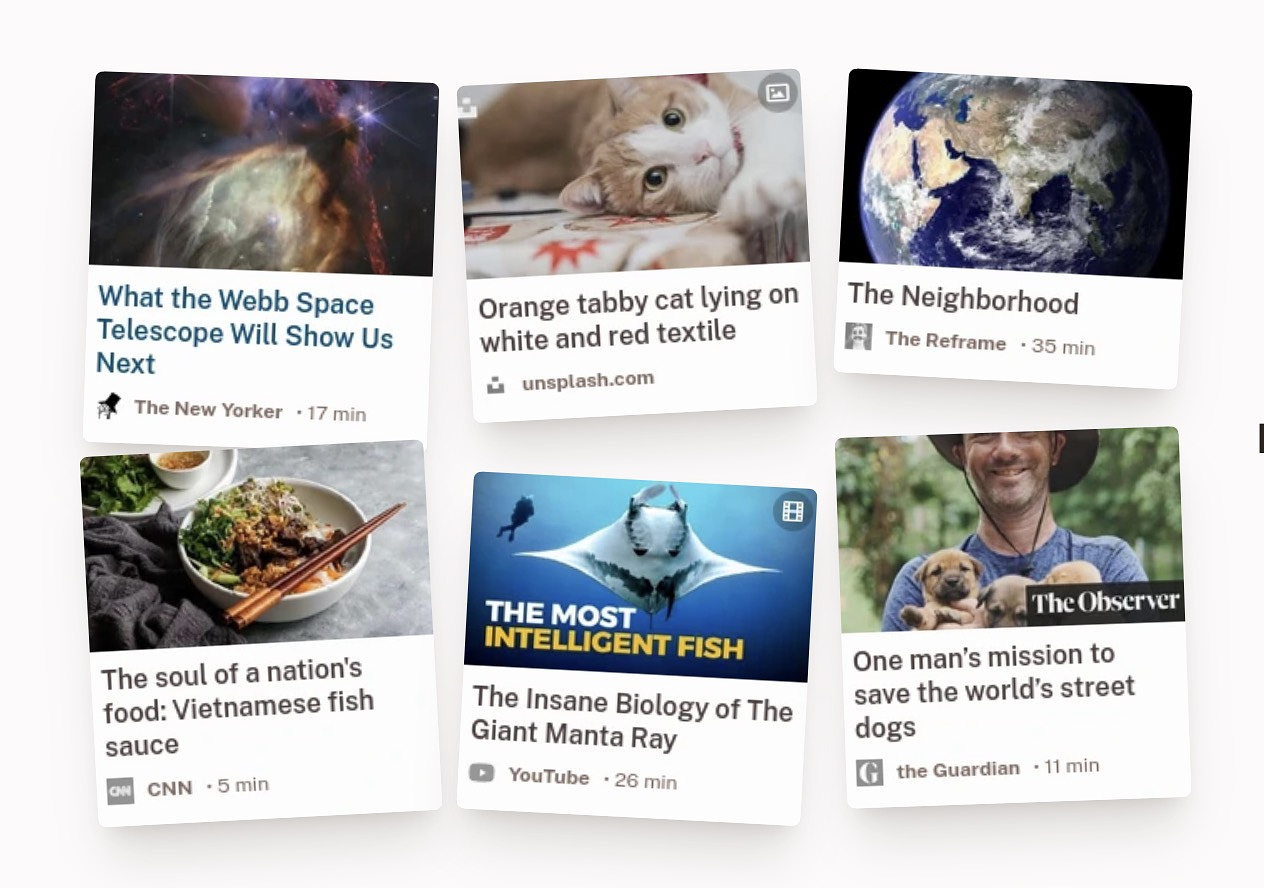
Readeck - (Free)a
web app that runs as PWA on a Mac with self hosting available this year.
It's an open source read it later application
Curate
Your World
- Archive, mark as favorite, add labels to your content so you can find it later.
- Search anything in your growing content and create dynamic collections. Highlight What Matters
- Highlight the key parts of any text content and come back to it later.
- Browse and find the highlights from all your content. Save Video Transcripts
- Save a video link and Readeck will retrieve the transcript when available.
- Read, export, highlight and search the save transcript as if it were an article. Export to E-Books
- Take an article with you on the ride home or a full collection for a weekend.
- Readeck lets you export articles and collections as a single ebook. It provides a standard catalog on supported e-readers. Adjust to Your Needs
- Read your way; set a different font, text size and line height.
- Readeck lets you do all that and remembers your preferred settings for your next read. Browser Extension
- Save while browsing with the browser extension.
- This includes the content on websites you can access but Readeck can't.
Czkawka
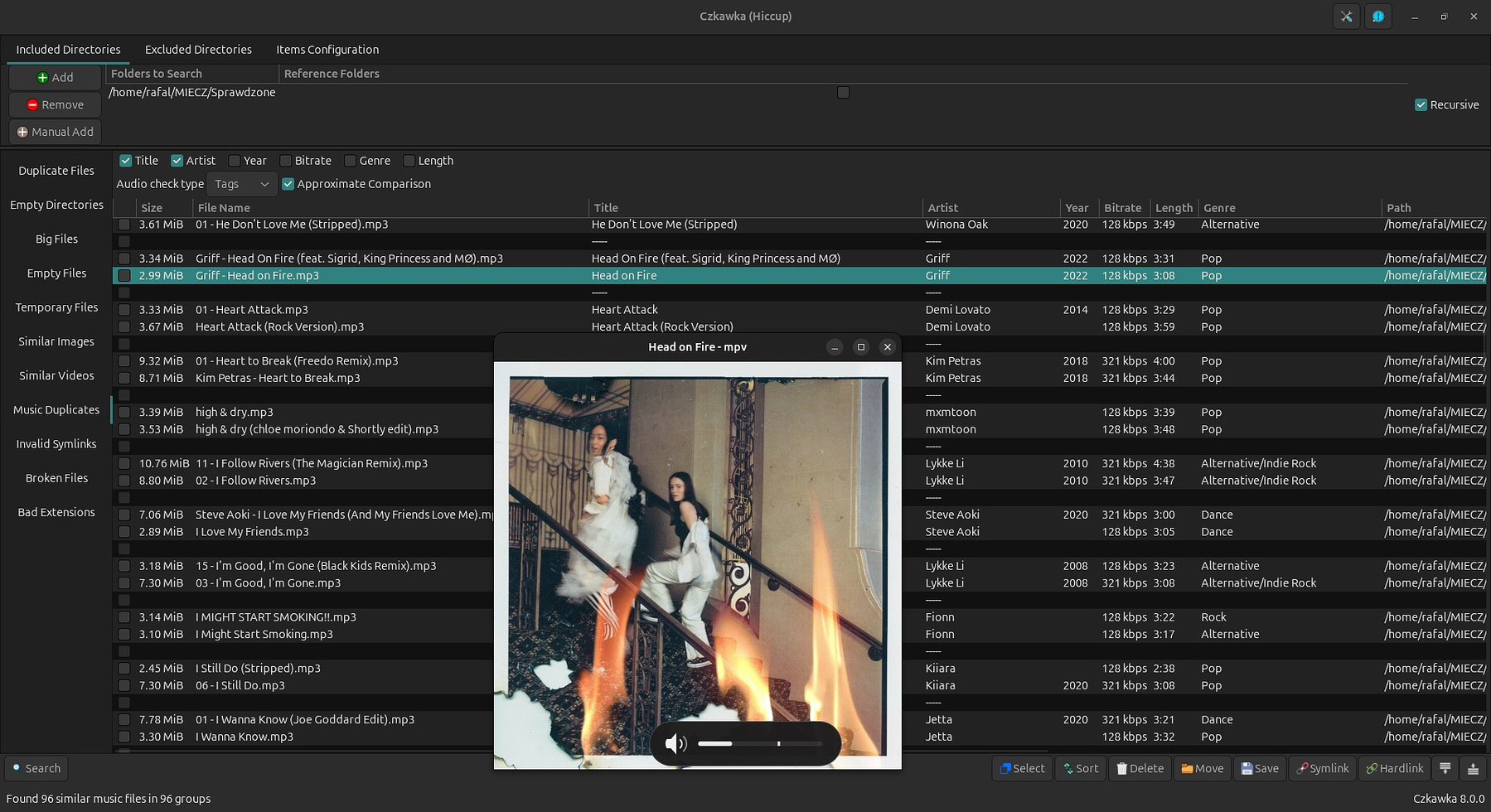
Czkawka
- (Free) - An open source app with multiple tools to
cut down on accumulated cruft on your Mac.
Multiple
tools to use:
- Duplicates - Finds duplicates based on file name, size or hash
- Empty Folders - Finds empty folders with the help of an advanced algorithm
- Big Files - Finds the provided number of the biggest files in given location
- Empty Files - Looks for empty files across the drive
- Temporary Files - Finds temporary files
- Similar Images - Finds images which are not exactly the same (different resolution, watermarks)
- Similar Videos - Looks for visually similar videos
- Same Music - Searches for similar music by tags or by reading content and comparing it
- Invalid Symbolic Links - Shows symbolic links which point to non-existent files/directories
- Broken Files - Finds files that are invalid or corrupted
- Bad Extensions - Lists files whose content not match with their extension
Legcord
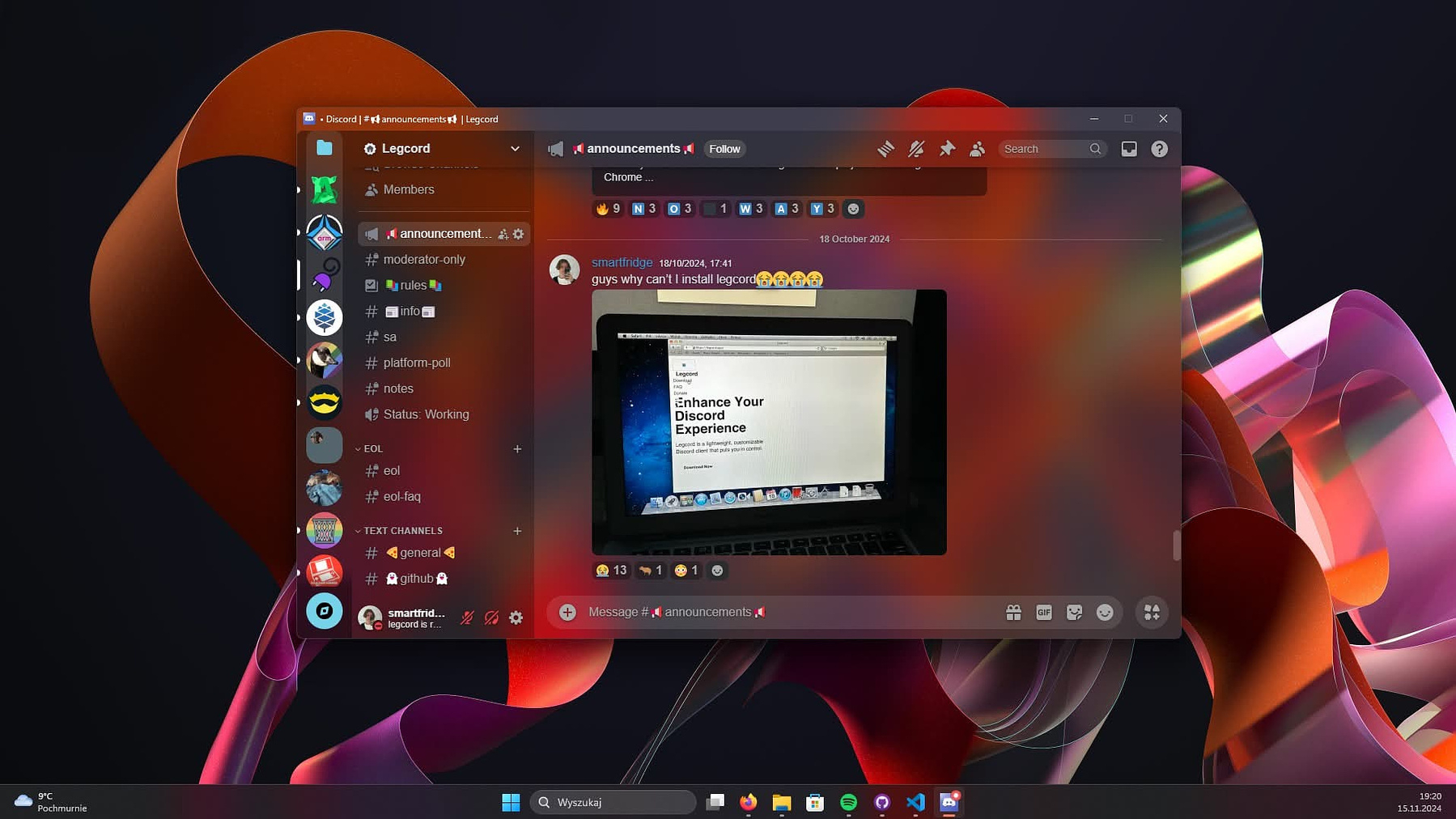
Legcord - is here to help you hate
Discord less. It's a lightweight, free and open-source Discord
client.
Highlights
- Uses a new lightweight electron framework
- Built-in game detection tools
- Very hackable for you developer types
- Made for privacy - Legcord automatically blocks all of Discord's trackers; even without any client mods, you can feel safe and secure! They also don't collect any data from you.
- Designed for Mac - Legcord is optimized for macOS, with a native screen sharing and a more Mac-like experience. It's optimized for both Apple Silicon and Intel macs! No more spinning fan when opening Discord.
Five New to Me Apps for a New Week
iDrive Cloud Backup
From Assaf at Labnotes - IDrive Cloud Backup I started looking into Backblaze alternatives, and so far iDrive is a strong contender. I chose the mini plan, 500GB of backup for $9.95 a year (it’s somewhere in the UI, look it up). It does have continuous backup, but so far I’m happy just running on a schedule. Can’t figure out how to get it to ignore repeat directories like every node_modules, or limit by file type/size (eg don’t backup large videos). And the UI is not pleasant, but neither is Backblaze (their restore is overly complicated), so just trading one deficiency for another. Oh, but they do give you 100GB of space to sync files between your devices.
Command Keeper
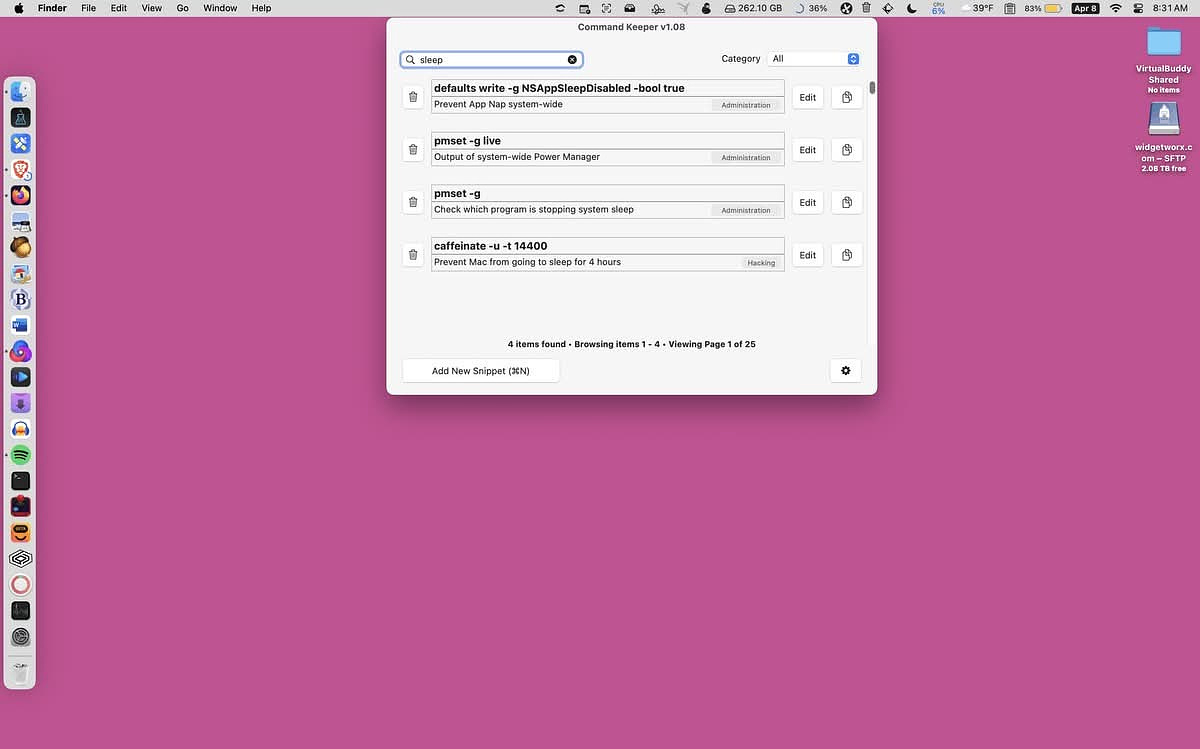
Command Keeper by Ari Feldman - Use Command Keeper (Free) to easily organize and access your command line snippets, shell scripts, and even SQL queries. It's ideal for app developers, web developers, or just anyone who needs to spend time working with command line interfaces.
- Build a Big Collection: Add or edit up to 999 command snippets (each can be up to 4K in size)
- Save Time: Automatically insert the selected command or query directly into your Terminal. Command Keeper works with your choice of the macOS Terminal or iTerm, Warp, and Ghostty (if installed)
- Always Ready: Runs in the background, so its always available and you can even pin your favorite snippets to always appear first
- Powerful Filtering and Search: Filter your snippets by category and search your snippets by command, description, and even notes contents
- Keyboard Friendly: Use keyboard shortcuts to create snippets and browse through snippets efficiently
- Preserve Your Data: Export your snippets to a CSV or JSON file and backup your snippet database
- Fast and Lightweight: Its simple and minimalist design ensures it’s light on resources
- Wide Compatibility: Works on macOS Ventura, Sonoma, and Sequoia; optimized for Intel and Apple Silicon CPUs
Readeck
Readeck - (Free)a
web app that runs as PWA on a Mac with self hosting available this year.
It's an open source read it later application
Curate
Your World
- Archive, mark as favorite, add labels to your content so you can find it later.
- Search anything in your growing content and create dynamic collections. Highlight What Matters
- Highlight the key parts of any text content and come back to it later.
- Browse and find the highlights from all your content. Save Video Transcripts
- Save a video link and Readeck will retrieve the transcript when available.
- Read, export, highlight and search the save transcript as if it were an article. Export to E-Books
- Take an article with you on the ride home or a full collection for a weekend.
- Readeck lets you export articles and collections as a single ebook. It provides a standard catalog on supported e-readers. Adjust to Your Needs
- Read your way; set a different font, text size and line height.
- Readeck lets you do all that and remembers your preferred settings for your next read. Browser Extension
- Save while browsing with the browser extension.
- This includes the content on websites you can access but Readeck can't.
Czkawka
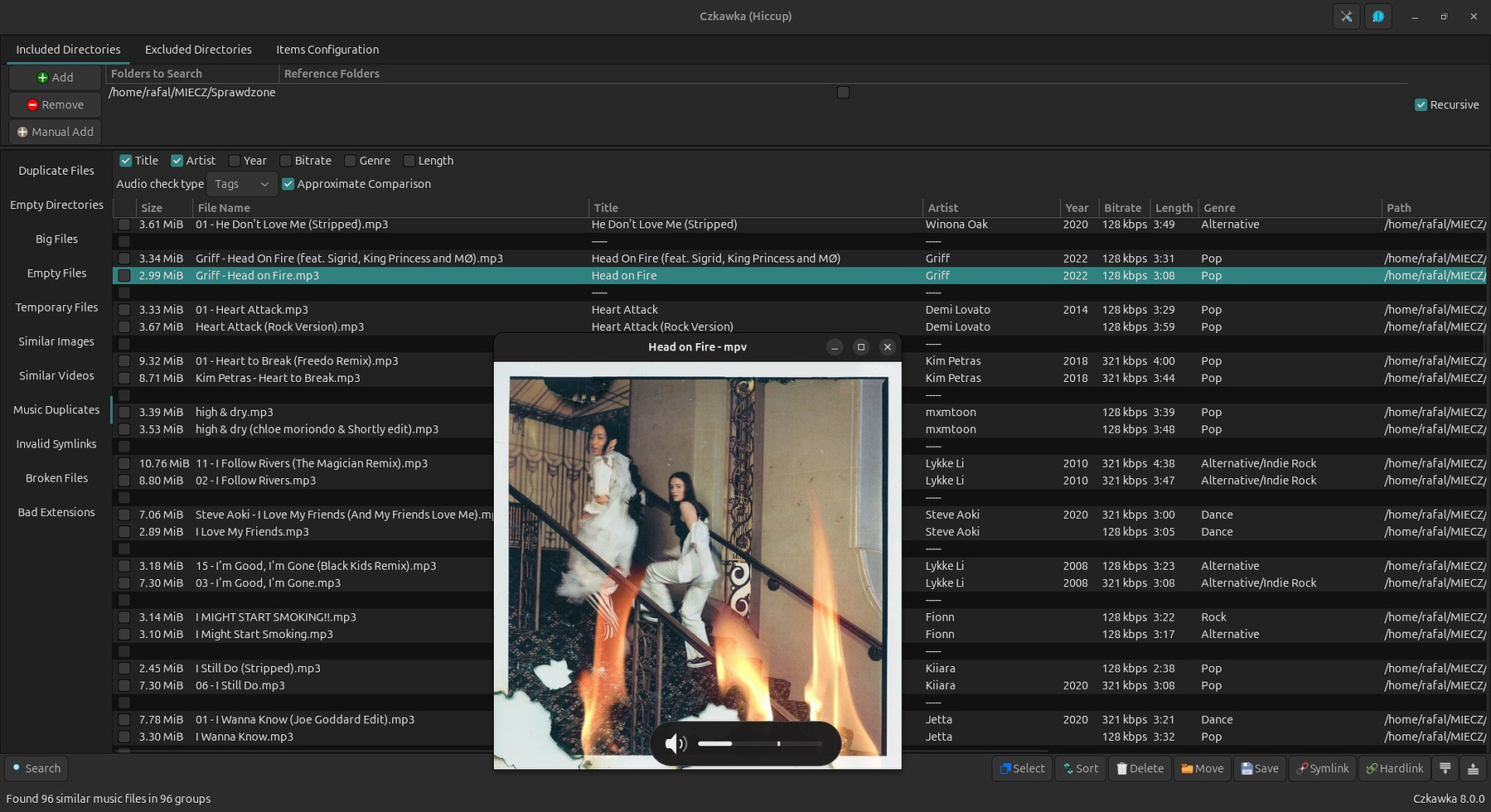
Czkawka
- (Free) - An open source app with multiple tools to
cut down on accumulated cruft on your Mac.
Multiple
tools to use:
- Duplicates - Finds duplicates based on file name, size or hash
- Empty Folders - Finds empty folders with the help of an advanced algorithm
- Big Files - Finds the provided number of the biggest files in given location
- Empty Files - Looks for empty files across the drive
- Temporary Files - Finds temporary files
- Similar Images - Finds images which are not exactly the same (different resolution, watermarks)
- Similar Videos - Looks for visually similar videos
- Same Music - Searches for similar music by tags or by reading content and comparing it
- Invalid Symbolic Links - Shows symbolic links which point to non-existent files/directories
- Broken Files - Finds files that are invalid or corrupted
- Bad Extensions - Lists files whose content not match with their extension
Legcord
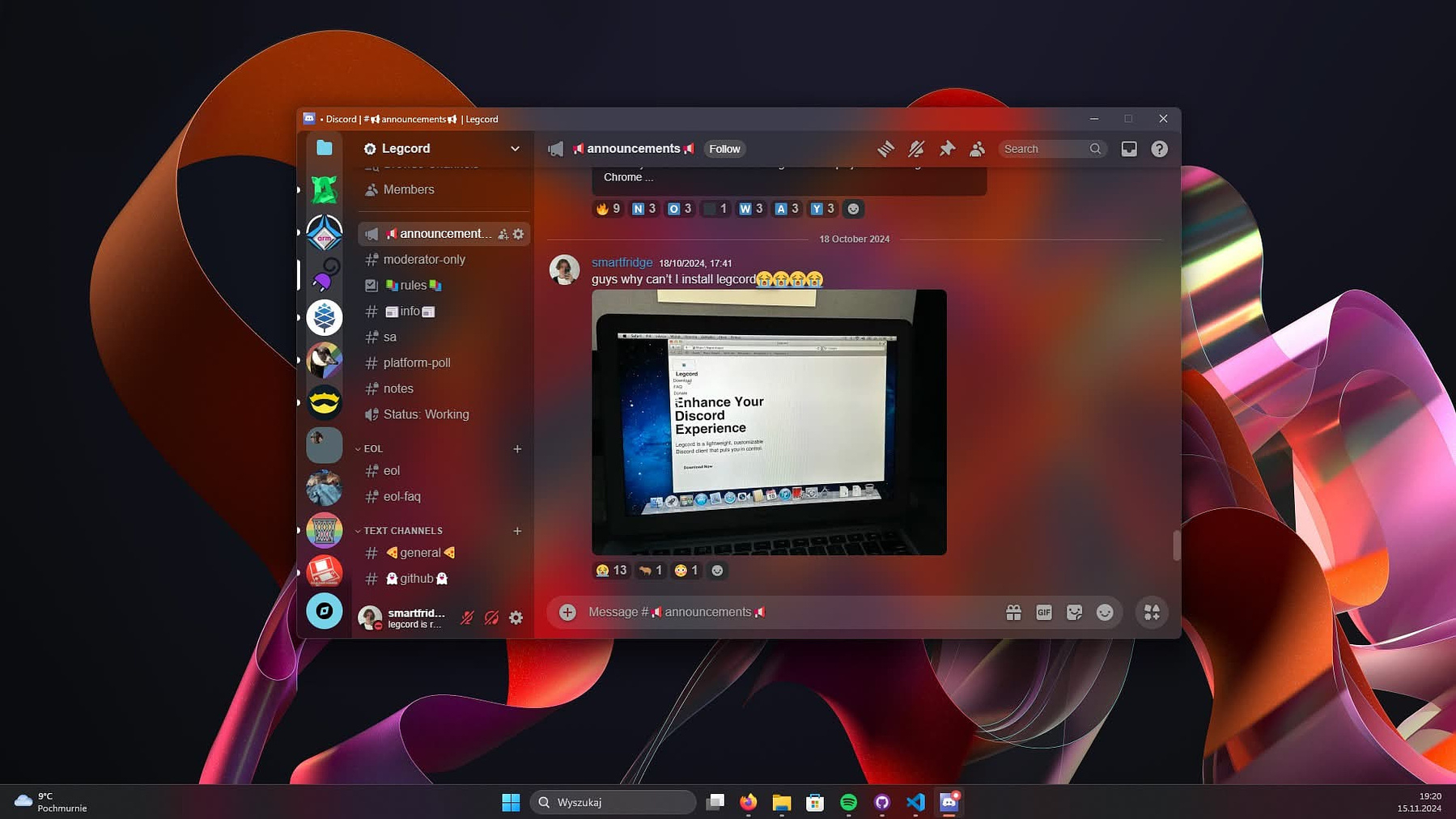
Legcord - is here to help you hate
Discord less. It's a lightweight, free and open-source Discord
client.
Highlights
- Uses a new lightweight electron framework
- Built-in game detection tools
- Very hackable for you developer types
- Made for privacy - Legcord automatically blocks all of Discord's trackers; even without any client mods, you can feel safe and secure! They also don't collect any data from you.
- Designed for Mac - Legcord is optimized for macOS, with a native screen sharing and a more Mac-like experience. It's optimized for both Apple Silicon and Intel macs! No more spinning fan when opening Discord.
How to Check All Your Apps for Homebrew Availability
I don't think there is any question on how useful the free Mac
package manager, Homebrew, can be. You
can download and install an app with just one simple terminal command,
something like:
brew install bbedit
After it's installed, there is no ZIP archive or DMG file to clean up or manage. To update you apps installed with Homebrew, you don't need a special app or a subscription to anything. You just open a terminal windows and run:
brew upgrade
Your apps will be upgraded in place with nothing for you to clean up. To back up your configuration, you just run
brew bundle dump
and a custom brewfile will be created at the root of your home directory. If you get a new Mac od do a fresh install on your current machine, you can use that brewfile to download all your apps and packages with one command.
If you are late to the party and already have an /Applications folder full of your favorite apps, don't worry, you can use a simple shell script to compare what you have installed with what is available for the Homebrew catalog. It won't take long to replace your manually installed apps with their Homebrew counterparts.
How To Check Your Applications Folder
Here is the script. It isn't 100% foolproof, so read the explanation and don't empty your trash until you've verified that the app you got from Homebrew is the same as the app you replaced.
\# List all applications in /Applications and ~/Applications
find /Applications -maxdepth 1 -type d -name "*.app" -print0 | while IFS= read -r -d $'\0' app_path; do
  app_name=$(basename "$app_path" .app)
  echo "Checking: $app_name"

  \# Sanitize the app name for Homebrew search (replace spaces with hyphens, etc.)
  search_term=$(echo "$app_name" | sed -e 's/ /-/g' -e 's/\./-/g' -e 's/@.*//') \# Basic sanitization, might need more

  \# Search Homebrew formulae
  brew search "$search_term" | grep -i "^$search_term$" && echo "  Found in Homebrew formulae"

  \# Search Homebrew casks
  brew search --cask "$search_term" | grep -i "^$search_term$" && echo "  Found in Homebrew casks"
done
Explanation:
- The script finds all .app directories in /Applications and ~/Applications.
- It extracts the application name.
- It performs basic sanitization of the name to make it more suitable for a Homebrew search.
- It uses brew search and brew search --cask to look for matches in both Homebrew formulae (command-line tools and libraries) and casks (GUI applications).
- The grep -i "^$search_term$" part tries to find exact matches (case-insensitive).
How to use:
- Save the script to a file (e.g., check_brew_availability.sh).
- Make it executable: chmod +x check_brew_availability.sh.
- Run it from your terminal: ./check_brew_availability.sh.
Limitations of this script:
- Naming variations: Homebrew package names might be significantly different from the application bundle names.
- False positives/negatives: The simple name sanitization might lead to incorrect matches or miss potential ones.
- Manual review needed: You'll likely need to manually inspect the output to confirm if the Homebrew package is indeed the same application you have installed.
In case you are wondering, this script and the instructions were written with the help of an LLM coding GPT. I've tested it on several different Intel and Apple Silicon Macs with solid results.
How to Check All Your Apps for Homebrew Availability
I don't think there is any question on how useful the free Mac
package manager, Homebrew, can be. You
can download and install an app with just one simple terminal command,
something like:
brew install bbedit
After it's installed, there is no ZIP archive or DMG file to clean up or manage. To update you apps installed with Homebrew, you don't need a special app or a subscription to anything. You just open a terminal windows and run:
brew upgrade
Your apps will be upgraded in place with nothing for you to clean up. To back up your configuration, you just run
brew bundle dump
and a custom brewfile will be created at the root of your home directory. If you get a new Mac od do a fresh install on your current machine, you can use that brewfile to download all your apps and packages with one command.
If you are late to the party and already have an /Applications folder full of your favorite apps, don't worry, you can use a simple shell script to compare what you have installed with what is available for the Homebrew catalog. It won't take long to replace your manually installed apps with their Homebrew counterparts.
How To Check Your Applications Folder
Here is the script. It isn't 100% foolproof, so read the explanation and don't empty your trash until you've verified that the app you got from Homebrew is the same as the app you replaced.
\# List all applications in /Applications and ~/Applications
find /Applications -maxdepth 1 -type d -name "*.app" -print0 | while IFS= read -r -d $'\0' app_path; do
  app_name=$(basename "$app_path" .app)
  echo "Checking: $app_name"

  \# Sanitize the app name for Homebrew search (replace spaces with hyphens, etc.)
  search_term=$(echo "$app_name" | sed -e 's/ /-/g' -e 's/\./-/g' -e 's/@.*//') \# Basic sanitization, might need more

  \# Search Homebrew formulae
  brew search "$search_term" | grep -i "^$search_term$" && echo "  Found in Homebrew formulae"

  \# Search Homebrew casks
  brew search --cask "$search_term" | grep -i "^$search_term$" && echo "  Found in Homebrew casks"
done
Explanation:
- The script finds all .app directories in /Applications and ~/Applications.
- It extracts the application name.
- It performs basic sanitization of the name to make it more suitable for a Homebrew search.
- It uses brew search and brew search --cask to look for matches in both Homebrew formulae (command-line tools and libraries) and casks (GUI applications).
- The grep -i "^$search_term$" part tries to find exact matches (case-insensitive).
How to use:
- Save the script to a file (e.g., check_brew_availability.sh).
- Make it executable: chmod +x check_brew_availability.sh.
- Run it from your terminal: ./check_brew_availability.sh.
Limitations of this script:
- Naming variations: Homebrew package names might be significantly different from the application bundle names.
- False positives/negatives: The simple name sanitization might lead to incorrect matches or miss potential ones.
- Manual review needed: You'll likely need to manually inspect the output to confirm if the Homebrew package is indeed the same application you have installed.
In case you are wondering, this script and the instructions were written with the help of an LLM coding GPT. I've tested it on several different Intel and Apple Silicon Macs with solid results.
Glide — A Reading Aid for Those With Concentration and Perception Challenges
Luckily, I don't have a diagnosis of ADHD or dyslexia, although
anyone who spends much time online quickly becomes aware that those
challenges are common among people of all walks of life, including tech.
I'm old, so I lived a good thirty years before widespread Internet
access arrived in the 90s. In the olden times, I was a voracious reader
of books. Gradually through the years, my ability to concentrate eroded
bit by bit until, like most people these days, I rarely even read all
the way to the end of news articles unless I really force myself.
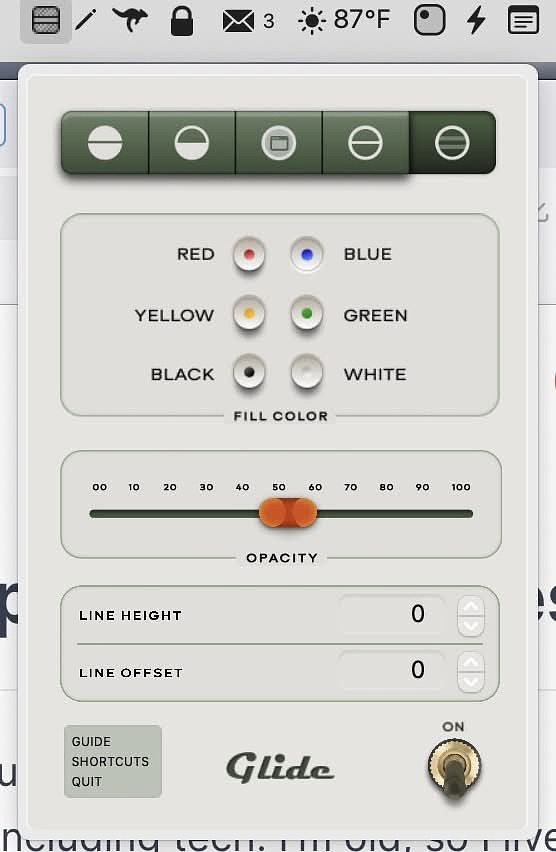
The developer from Applorium LTD contacted me and asked me to take a look at Glide, an app made especially for people with ADHD and dyslexia. The app has five different tools to isolate text on a page. You can choose one of six different colors to partially color the part of the screen that you are not reading. You control the opacity, and you decide how much of the page you want to highlight. You can narrow it down to just a thin line that moves down the page as you read of you can hide everything but what you are reading. It's harder to describe than it is to use. I got the hang of it in less than a minute.
Everything can be controlled from a menu bar icon or from user-defined hotkeys. There is a well-written guide to get you started, should you need it. It's not long or difficult to understand.
I've got to say, that using the app to read a detailed article on some complicated Linux related material really helped me concentrate in a way that I didn't expect. It has practically no impact on my computers' performance, so I will have no problem toggling it on whenever I have the need to make the extra effort to retain important info.
The app is currently $5.99 in the App Store.It appears that the developer is responsive to user input, as he has made numerous updates since first releasing the app. Almost every element in the interface, from color, to opacity to line height can be adjusted.
Even if you don't feel that you require this app, please suggest it to anyone in your circle with concentration or perception challenges.
NameQuick Comes in Handy
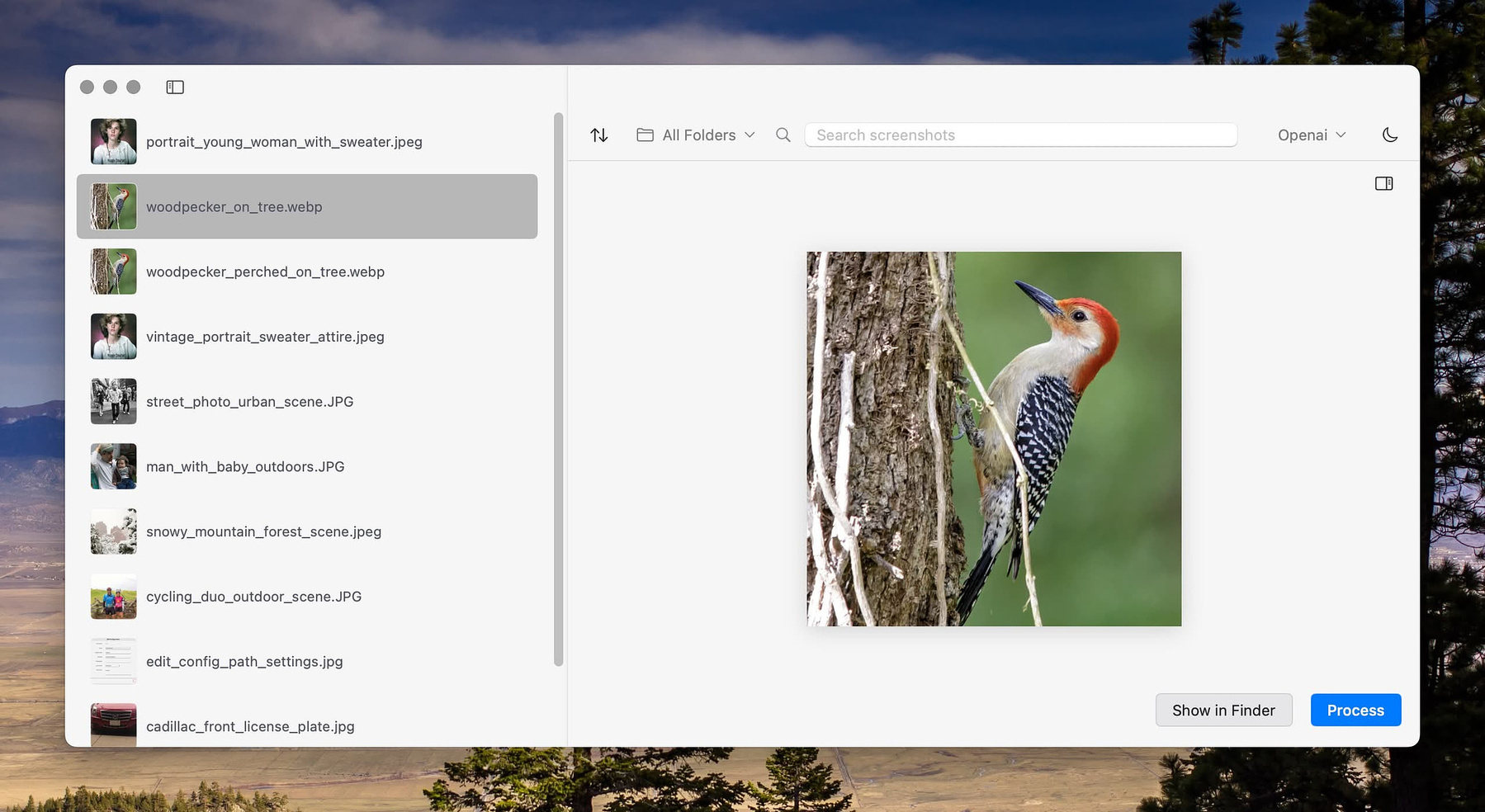
No matter how consistent you are, your computer is more consistent. One of my hobbies requires me to do frequent file exports, and I've just never come up with a consistent naming scheme to provide me the information I want at a glance. I always have to get info or switch Finder to show details to differentiate between different versions of the files I use. NameQuick, an Ai-driven file naming utility by indy developer Josef Moucachen, is a full-featured app with numerous automation options.
There isn't a free trial, but there is a three-day period to get a refund, so you can still safely see if the app works for you. You have to enter a registration key to use the app. There are currently two licensing options, $19 for one Mac and $29 for three Macs, and priority tech support. Those are one-time payments and not subscriptions.Both of these options require you to use your API keys from Open AI or Gemini, or you can use Ollama, a local LLM. If you don't have an API key, the link to get one is in the app.
NameQuick requires accessibility access and asks that you enable notifications. You have the option to turn on full-disk access if you would rather not bother approving various folders one at the time.
When setting up the app, you can set up watched folders and any new files that are placed in them will be renamed based on their content and any rules you set up. You can specify that only files that begin a certain way get renamed, or that only files with a certain extension. You can have AI extract patterns from your files to include in the name, such as the name of a client or project, the location of a photo shoot or the date.
You can invoke NameQuick by a user definable hot key or by selecting files in the finder and using the menu bar icon.
I tested the app on some random photos I recently used in a blog post. I had it rename some PNG files of screenshotted text quotes, and I threw some complicated CSV files at it. I also had it parse out files names from a folder of PDF invoices. Out of 25 files, I only had to manually rename one that, I felt, wasn't adequate. I used both OpenAI and Gemini in my testing.
I would like to see the developer add integration into the services' menu, since I use that often in my workflows. I am also an automation junkie, so having shortcut support would also be nice. I would like to be able to click on a file or group of files and have "Rename with NameQuick" as an option. The other feature request I have is the ability to include file attributes as variables in the name, such as the file creation date or camera info from EXIF data.
"NameQuick supports a comprehensive range of file types including • Images: PNG, JPG, JPEG, HEIC, WEBP • Documents: PDF, TXT, MD • Spreadsheets: CSV • Video: MP4, MOV, AVI, MPG, MPEG, WMV, 3GP, WEBM, FLV • Audio: MP3, WAV, AAC, FLAC, M4A, OGG, OPUS"
It Might Be Time to Get Rid of Backblaze

Backblaze offers two products to Mac users. The first and oldest
is an always on backup service that backs up your entire hard drive to
the cloud. In the event of a hard drive crash, theft or disaster, they
will mail you a USB drive with the entire contents of your drive so that
you can restore to a new device. For incremental restorations, you can
recover files online after making a request for what you want. Their
other product is online storage similar to Amazon's AWS or Microsoft
Azure.
The personal backup plan is $9
a month or $99 a year. I've used the service in the past and was
impressed by how easy it was to use. I never had an issue
.
There seem to be numerous problems with the business end of the company that do not bode well for its future, however. Morpheus Research, a business analyst, recently released a pretty scathing report on Backblaze.
Backblaze, in our view, is the archetype of a failed growth business and its latest "restructuring" will do little to resurrect the company's woeful capital market performance or transform its undifferentiated storage offering. Its capital markets story has been kept alive by allegedly inflated cash flow forecasts, hidden internal investigations and accounting tricks, which appear to fuel exit liquidity for insiders.
What that means is the company has been using voodoo accounting tricks to hide its massive losses, and the stock and the company are headed for a big crash that could leave any Mac user who depends on Backblaze in a bad place. I would suggest moving to another service as quickly as possible. Wasabi has plans starting at $6.99 per TB per month that allow you to use your own backup software, like Arq to back up to their cloud servers.
Make dupeGuru Part of Your Maintenance Toolbox
As a non-developer, I appreciate how difficult writing good software must be. There are a few tasks that it seems are nearly impossible to prefect. Finding duplicate images is one of them. Apps that use machine logic to identify images with different file names, different creation dates, file sizes and even image dimensions seem to have an almost impossible task. One of my ongoing projects is curating a lifetime of photos that include scanned paper photos, images from various digital cameras and every smartphone my wife and I have ever owned. The images have been in iCloud, in Google Photos, Amazon photos and one various Macs and backup drives through the years.
I am fine with using multiple tools. I realize after working on this for a while that no single application is going to find all the duplicates.
I found a great many dupes using Gemini by Macpaw.
I also used the freeware duplicate finder, ZeroDuplicates.
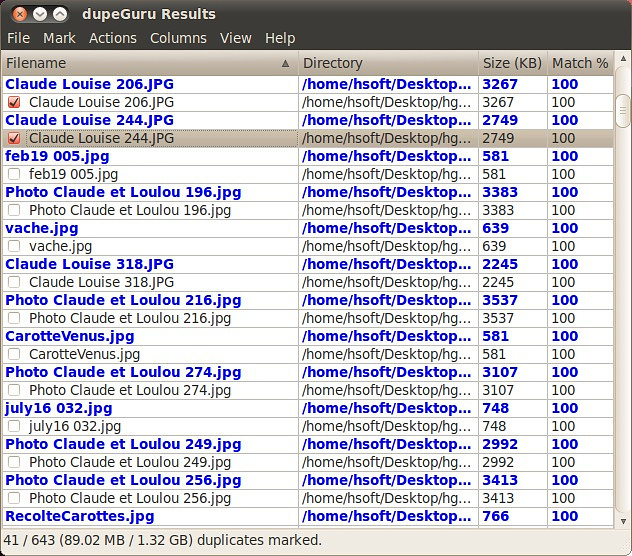
I'm now scanning the same directories with another free app and still finding files to remove. The app I am using is a free and open-source offering available on GitHub for macOS, Windows and Linux. It's called dupeGuru and it is pretty powerful in its own right. It has three modes: regular files, music, and images. "dupeGuru is customizable. You can tweak its matching engine to find exactly the kind of duplicates you want to find. The Preference page of the help file lists all the scanning engine settings you can change.
dupeGuru is safe. Its engine has been especially designed with safety in mind. Its reference directory system as well as its grouping system prevent you from deleting files you didn’t mean to delete.
Do whatever you want with your duplicates. Not only can you delete duplicates files dupeGuru finds, but you can also move or copy them elsewhere. There are also multiple ways to filter and sort your results to easily weed out false duplicates (for low threshold scans)."
Apps For Travelers

When I travel, my phone ceases to be an entertainment and
diversion device and turns into a real tool. Whether I'm staying in town
or on an outdoor adventure, I rely on my phone for directions and
information about things to do and places to go. Here are a few of the
apps I find helpful.
History Pointer
History Pointer uses your current location to show you locations on the National Historic Register. I was amazed to see how many places in my own hometown were listed. You get maps, Wikipedia excerpts and an augmented reality tour. ($4.99)
Gas Buddy
Last weekend, my gas light came on while I was way out in the country carrying my granddaughter to work at the horse farm that employs her. Luckily, I have Gas Buddy installed. I use it without signing in and only letting it use my location when I'm actively searching for gas.
Organic Maps: Offline Maps
There are some excellent offline map apps that are very expensive. Then there is Organic Maps, an excellent offline map that's free. You just need to plan ahead and download the maps for the area where you plan to travel. It does directions for walkers, cyclists and drivers. It uses Open Street Maps data and was just updated this month.
Rego
Rego bookmarks geographic locations. Whenever we travel, it's easy to find places where we've enjoyed eating in the past. The same with coffee shops and hotels and rental properties. Adding a new location can be done onsite, from an address or pulled from the metadata from a photograph. Bookmarks contain GPS coordinates, street address where applicable, notes, date added and a stock photo or one or more of your own. You can also use custom pin colors and designate any location as a favorite. ($9.99 yr. / $24.99 lifetime)
iExit
If you do any traveling on the Interstate highway system, iExit, helps you find gas, food and bathroom access. I use it on every trip. The information is plentiful and up to date. (IAP $1.99 to remove ads)
Get Plain Text - Adds a Feature the Mac Lacks

People who work with text a lot are familiar with the Mac shortcut to paste the clipboard as plain text - Command + Shift + Option + V. This shortcut works in many native Mac applications like Pages, Mail, and Safari. When you copy content from a source and use this shortcut to paste, it automatically strips away any formatting. While the shortcut is highly versatile, it only works sometimes. Applications like Microsoft Word or third-party software may not support it natively. You can learn application-specific methods of pasting as plain text. Word has a way to do it. So does Google Docs. It is easier, however, to find and use an application that will just take care of this for you.
A good choice is an app that has been round for over a decade, Get Plain Text, available for free (with an IAP to tip the developer if you'd like to.) "It instantly removes everything unneeded: colors, typeface size, style (for example, boldface/italics), hyperlinks, images, etc. In other words, everything that isn’t plain text! Now you can put plain text in your letters and documents using the copy/paste functions, without having to clean it up manually. Get Plain Text will convert any bit of text into plain text, no matter where you copied it from (a website, PDF document or elsewhere). You can activate the feature manually, or check “Automatically remove formatting” to make the app take care of it every time you copy something."
There are other apps that offer similar functionality if you are sketched out by the length of time since this app has been updated (9 years, LOL). The handling of text formatting is long-established, programmatically, so IMHO, there's nothing to fear.
- TextSoap - $50, multifunctional, also available through Setapp
- PurePaste (free) from Sindre Sorhus - always a good choice. This app can exclude certain apps, preserve links, normalize (quotes, newlines, lists, etc.) and also remove tracking parameters from URLs.
- Some clipboard managers offer this feature as an option in their settings, including PasteBot($12) and ClipMenu (free).
Quick App Launcher - Pro, A Well Thought Alternative
There are various ways to launch apps on a Mac. The most obvious
and the one used most by new Mac users is clicking icons in the dock.
Apple also has Launchpad another built-in launcher. More advanced users
sometimes move on to keyboard-driven methods, starting with Spotlight
and advanced launchers like Raycast or Alfred, although some don't want
the added system overhead or extra features. Some like the convenience
of a menubar launcher like Xmenu
or Folder Peek.
Lately, there has also been a growing popularity among so-called pie
menu launchers like Pieoneer.
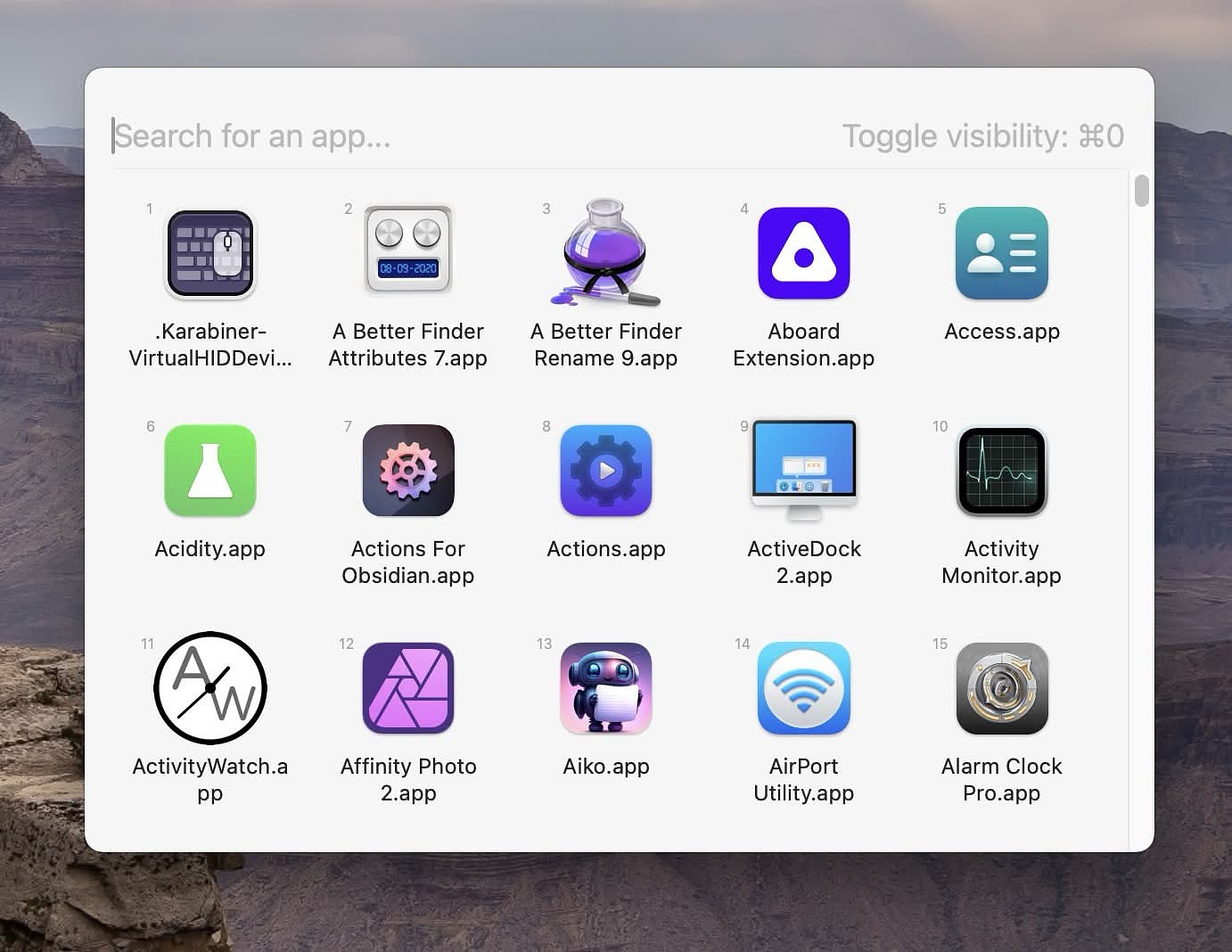
Another choice now available from developer Baser Kandehir, is a well-thought-out pop-up palette of applications through which you can sort in various ways. The app is called Quick App Launcher - Pro. You summon the application window with a user-defined keyboard shortcut or by clicking its icon in the menu bar. You can choose one of three window sizes to display your installed list of applications, which, without filtering, are displayed in alphabetical order. As you begin to type, the apps filter based on what you've entered. If it works for you, you can scroll through the list and click on what you are trying to launch. There are several methods of launching from the menu, including entering the numbers 1-9 to correspond with the grid pattern, typing a partial match, and clicking one of the choices or typing until nothing else matches, at which time the app will launch.
If you only want to use Quick App Launcher - Pro on a subset of your apps, that's no problem. In the settings, you can toggle off anything you don't want to launch with the app. Everything is turned on by default. You can also choose whether it launches Safari Web Apps or not. Other options in the settings include choices for the background of the application window, toot tip visibility, and whether numbers appear beside the apps while you search. Currently, the numbers are a little difficult to see, so hopefully that feature will be improved. The tool tip and window background features still need some refinement, as the changes I toggled were not apparent. The app does have dark mode compatibility.
The developer told me he is working on additional features and refinements. I would like to see the following:
- The ability to open folders in the finder
- The ability to open files
- The ability to open URLs
- Being able to specify what folders to search for applications, since some people offload big apps to external drives or keep them in non-standard locations.
Quick App Launcher - Pro is $5.00
as a one-time payment. It
collects no data and can be used in Family Sharing.
Free App List Number 4

This is the fourth collection of free apps reviewed on AppAddict.
Links to the first three collections are posted below. I've downloaded
and installed each of these on my Mac. I've added many of these apps to
my workflows for getting stuff done.
Previous Collections
- A Curated Collection of Free Apps
- Another Curated Collection of Free Software
- AppAddict Free App List Number 3
Free App List Number 4
- Permissions Reset 2 - Free Troubleshooting Tool
- Zotero as a Free PDF Library Manager
- UTM for Virtualization
- rclone - An Easy to Use and Powerful CLI
- Syncthing - Free and Open-Source Cross Platform File Sharing
- Convert CSV Files to Markdown
- Hop to Desk, a Free and Open-Source Encrypted Remote Access Solution
- One For the Techies - SwiftDefaultApps
- Digikam is Replacing Apple Photos, Google Photos and Amazon Photos For Me
- Change the Location of Notifications With PingPlace
- SmartBackup - Free, Fast and Foolproof
- Pareto Security - Quick and Easy
- Local Send - Easy to Set Up and Easy to Use
- Using Joplin as a Reference Tool
- Fmail2 for Fastmail
- Stickier - Free Notes App with Power User Features
- Cog - Free and Open-Source Local Only Music Player
- Privileges - Operate Your Mac Safely
- Use KIWIX to Access Wikipedia and Other Resources Offline
- Librewolf for Security and Privacy
- Metadata Lab - Exif Editor
- Battery Monitor Health, Info
- Sandkorn - Comprehensive Information on Your Apps
- Privacy Badger Extension from the Electronic Freedom Foundation
- Libation - Audiobook Downloader and Converter
- Captin Solves a Major Mac Annoyance
Opener Feels Like iOS
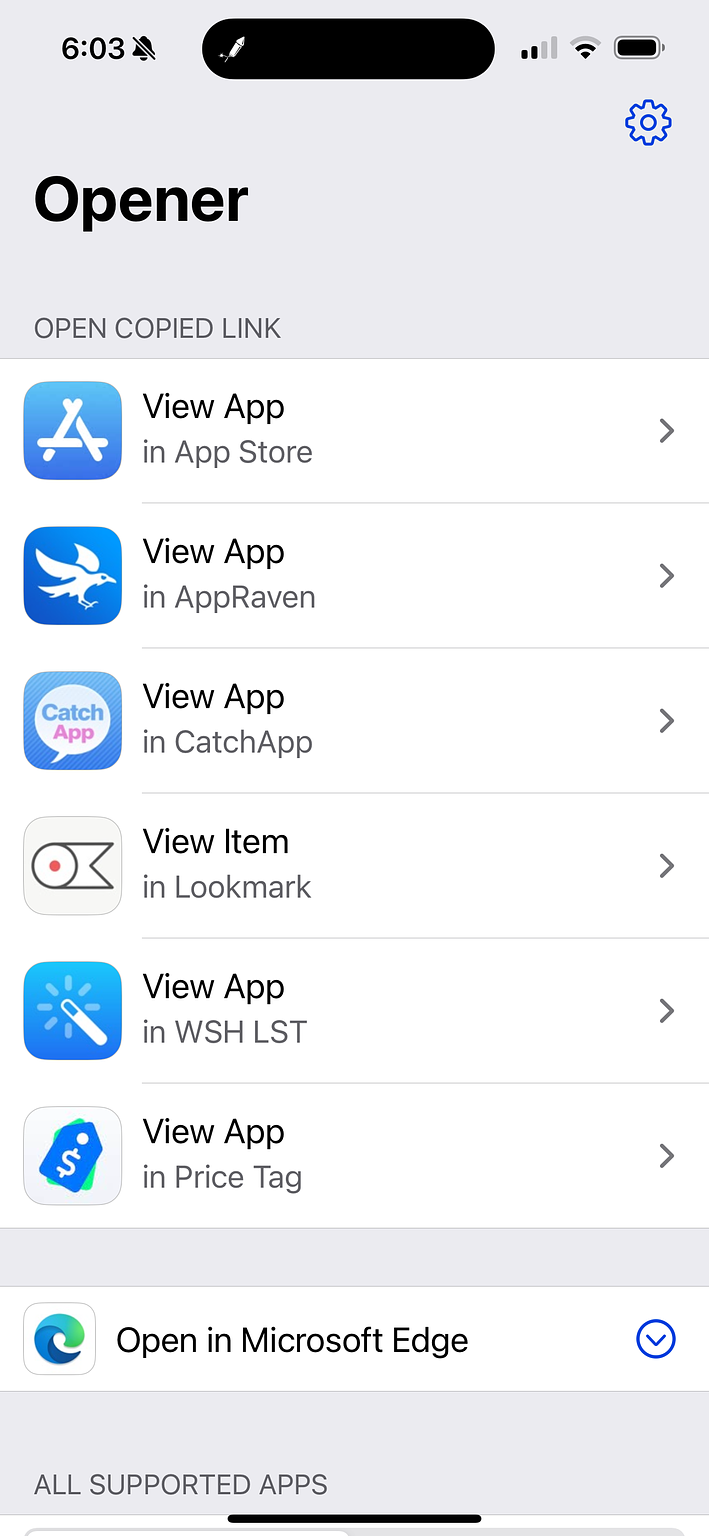
Opener is so integrated into the way I use my phone that I forget it's an app and not built into iOS. When you're browsing the web in your iOS browser and you come across a link you want to open, usually you have to copy and paste the address to get it into the app you want. Using Opener, you can go straight to the app from your browser or any app that allows sharing a URL. If, like me, you use an iOS browser other than Safari, Opener lets you send links to the browser of your choice. In fact it supports over 40 browsers! It's fully integrated into the share sheet and I have it at the top of mine. Out of the box it supports 240+ apps to include YouTube, Twitter, Ivory, Amazon, Spotify, Reddit and more. You can see a complete list on the developer's web site. It's $2 and well worth it in the App Store.
In the example above, I have an App Store Link on the clipboard. Opener presents all of these options for opening it.
MyApplications - An App for App Lovers
For the avid app collector there are a few tools available to help
catalog and curate the assortment of programs that accumulate over time.
You can use Apple's built in system report to get comprehensive
information but it's rather dense and not illustrated. You can use an
app like Apparency,
but then you are limited to a single app at the time. MyApplications,
available in the app store for 99 cents, serves as both a database and a
launcher for your computer.
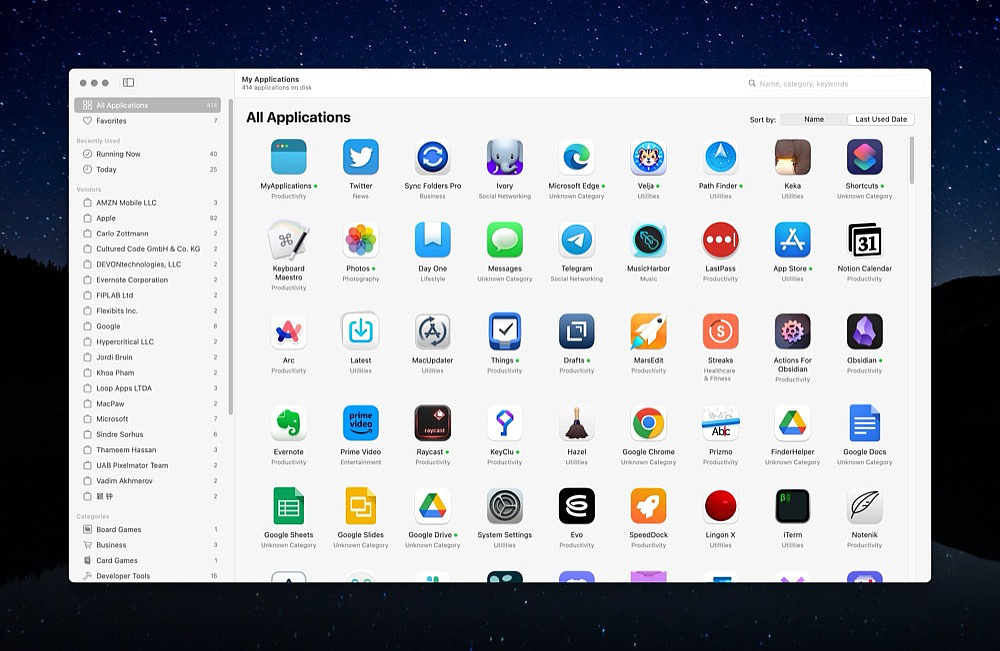
The MyApplications general interface includes a count of the
number of apps you have installed, 414 in my case. It breaks the apps
down into publishers, for example I have 92 apps from Apple itself and
six from the wonderful developer Sindre Sorhus. Apparently, many
apps don't provide publisher information because I have a lot that are
not listed. It also breaks the apps into categories such as utilities,
productivity, developer tools, graphics and design etc. The categories,
while helpful, are a little too broad for my taste, for example I have
124 labeled as utilities and it seems that could have been further
narrowed into categories like disk utilities, archive utilities, etc.
The app interface lets you choose sorting by name or last
launched. It tells you how many apps you currently have running and how
may you have launched in the past day. If you click on individual apps,
you have the option to launch them or to get more information regarding
size on disk, location, language localizations, download date and date
of last update. A complete permissions report is included. The package
contents are listed as is a complete description, apparently from the
App store or developer's web site if provided. There are even screen
shots provided.
(This is a repost. I’m out camping with my grandkids and didn’t
have a chance to test anything today.)
Pareto Security - Quick and Easy
I recently noticed an app on Setapp that I'd never tried, Pareto
Security, so I investigated it. It's a basic application that checks the
settings on your Mac and quickly shows you where you aren't following
the best recommended practices from security experts. It has links to
tutorials for every setting along with an explanation of why that
setting is recommended. Although it is geared towards less technically
advanced users, anyone can benefit from a quick scan.
Experienced Mac users are going to familiar with these best practices and will probably have legitimate reasons for any deviation from the suggested settings. Still, it convinced me to change my settings in a few areas:
- I use a third-party firewall app, but I have now also turned on Apple's firewall.
- I also turned on firewall stealth mode
- I turned off native file sharing because I use other ways of sharing files on my network
- I finally decided, for the first time ever, to try operating my Mac as a standard, rather than an admin user. I use an app called Privileges to convert to an admin account for short periods when I need to; otherwise I just enter the username and password of an inactive admin account, which every person should definitely set up.
- I'd delayed turning on File Vault, and this convinced me to finally flip the switch. I have no excuse for waiting so long.
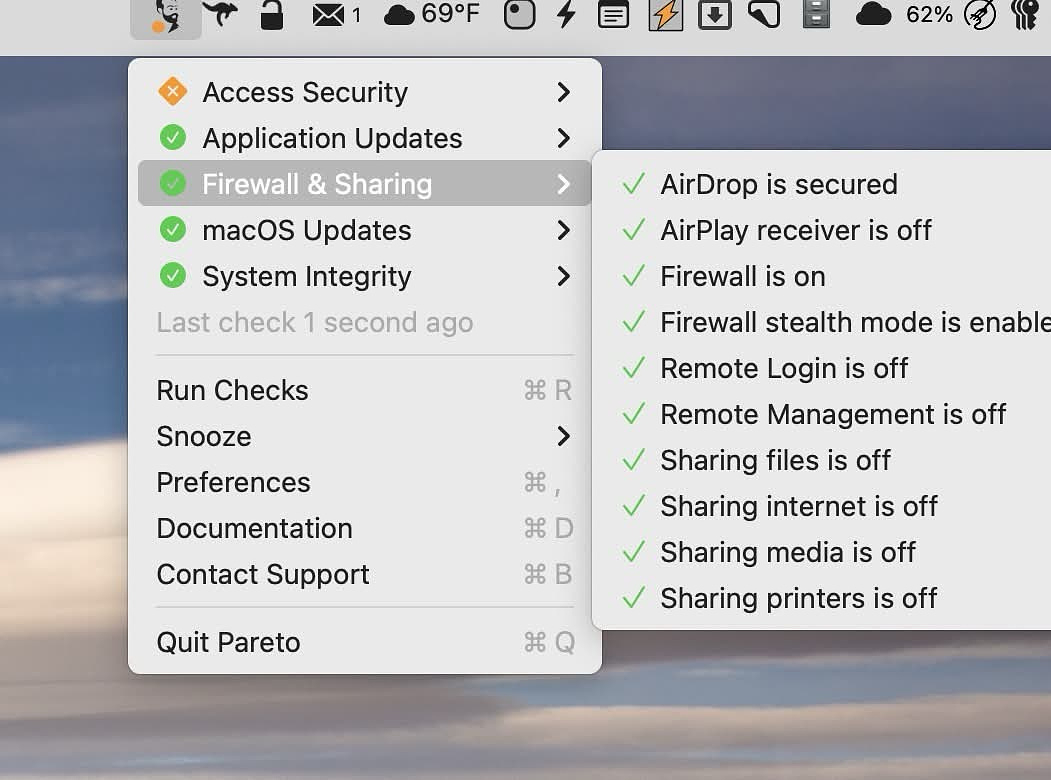
Pareto Security checks the settings in the following areas
- Access security - makes sure all important areas of your Mac are password protected and that your SSH setting are optimized for security
- Application Updates: - Checks your browsers, security apps (e.g., firewall apps like Lulu), alternative terminal and secure messaging apps (e.g., Signal)
- Firewall and Sharing - Checks Airdrop, Airplay, Firewall and all sharing settings
- macOS Updates - It gigs you if you don't have automatic updates turned on, so take these suggestions with a grain of salt.
- System Integrity - Checks your boot settings, File Vault, Gatekeeper, Terminal secure entry, Time Machine settings, and Wi-Fi connection
If you don't have Setapp, you can download a free trial of the app from Pareto and run the checks. I don't see any reason why a personal user would want to run this app continuously but in a managed setting, it is one good way to make sure your users are following the best security settings if you are not managing them through JAM or something similar.
SmartBackup - Free, Fast and Foolproof
While I have long used Time Machine as my primary backup for my
Macs, it does have some drawbacks. If you go looking for a missing file,
it's a hit-and-miss operation to find the last known good copy of a
document, image or folder. You basically have to work your backwards
through your snapshots until the file appears. You also have to know the
exact path of what you're looking for unless you are willing to restore
in bulk.
The type of backup I need isn't a whole disk backup. I'm fine with Time Machine for that, plus I have the option of using SuperDuper!, Carbon Copy Cloner or DiskDrill. for copying a whole disk, something that is much more nuanced and complicated using AFPS than it was ever using HFS.
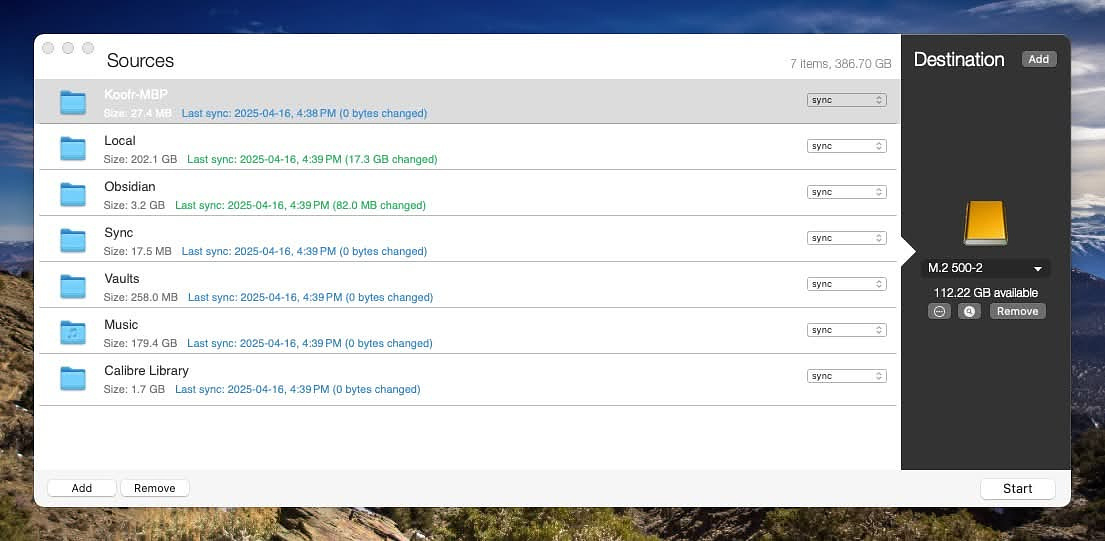
After testing several options, some of them excellent, others not so much, I decided to use the free product, SmartBackup because I liked its basic interface, multiple options for backing up, and its easy to understand and use restore mechanism which works through the Finder. SmartBackup will optionally archive changed or deleted files in timestamped folders. You can choose how long you want to keep these files. The restore feature includes a built-in search panel that will show you multiple versions of a file grouped neatly in the results.
The other attractive feature is the speed at which it backs up, especially to an SSD drive plugged directly into a Thunderbolt port. It's engineered to take advantage of SSD technology and even allows you to choose the number of data threads you want active at one time. The default, two, should be used if you are backing up to a mechanical hard drive, but from SSD to SSD, four worked better for me.
The built-in scheduler is simple. You pick a time and specify if you want to perform a daily or weekly backup. It will run in the background without launching a window and notify you when it is done.
SmartBackup works on Intel and Apple Silicon.
You can download SmartBackup at the developer's website.
Note - I tested three other products, two of which work well: FreeFileSync and SyncFolders Pro. The product that underperformed dismally was ChronoSync Express. I'd heard good things about it, but it was exceptionally slow and failed three times to back up my home directory. I was surprised because it had been recommended to me by a couple of people.
I have a couple of newsletters now. One is a weekly collection from my personal and links blogs that goes out on Mondays. - ✏️ Subscribe | Amerpie by Lou Plummer
The other newsletter is for this blog, one app review delivered to your mailbox every day. in case you don't have enough software in your life - Subscribe | AppAddict Newsletter
Change the Location of Notifications With PingPlace
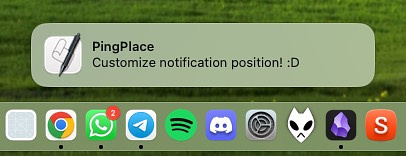
One of my favorite tech writers, Justin Pot, who
publishes a lot over at Lifehacker, reviewed a new to me app today
called PingPlace. If something happens on a Mac, someone is going to
figure out a way to tweak it. This free app moves the pop-up location
for notifications from the upper-right corner's default, to just about
anywhere else on your primary display that you'd like to see them
appear"
- Top Left
- Top Middle
- Top Right
- Bottom Left
- Bottom Middle
- Bottom Right
Reasons For moving the default location include the size of your monitor, or just plain personal preference.
The only real option in the settings is to have the application launch at startup, which only makes sense.
The apps requirements are a minimum of macOS 14 and accessibility permissions.
You can download it on GitHub, or even better, get it via HomeBrew.
brew tap notwadegrimridge/brew
brew install pingplace --no-quarantine